


AI Search Optimization for Luxury Brands
The way people search for travel recommendations is changing. AI search optimization for luxury brands is now essential, as travelers increasingly ask ChatGPT, Claude, and Perplexity for personalized recommendations instead of scrolling through Google results. If your luxury hotel or boutique property isn’t visible to these AI platforms, you’re missing this growing audience.
Executive Summary
Quick takeaway:
AI search optimization for luxury brands determines whether hotels and boutique properties are recommended by platforms like ChatGPT, Claude, and Perplexity. Visibility depends on clear positioning, factual content, third-party authority, and reputation signals.
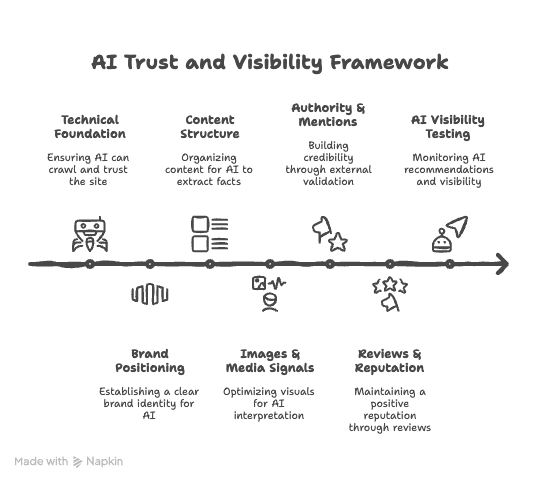
This framework is informed by original research, including the Invisible or Influential: Luxury Travel in the Era of AI Search study.
What is AI Search Optimization?
Why AI Search Optimization for Luxury Brands Is Different from Traditional SEO
Definition: AI search optimization makes your brand visible when people ask AI platforms for suggestions. Unlike traditional SEO, which focuses on ranking in search results, AI search optimization ensures your business appears in conversational AI responses.
Example: When someone asks ChatGPT “What are the best boutique hotels in Barcelona?” or Claude “Recommend a luxury spa resort in Bali,” they get direct recommendations. Your goal is to be one of them.
Why This Matters Now
Millions of users now rely on ChatGPT, Claude, Perplexity, and Google’s AI Overviews for travel planning. These platforms are becoming the new front door to discovery, especially for high-end travelers who want curated, personalized suggestions over generic search results.
Insights from our Invisible or Influential: Luxury Travel in the Era of AI Search study show how AI-driven recommendations are reshaping visibility for luxury brands – and why authority signals now outweigh traditional ranking factors in AI responses.
The key difference: Traditional SEO alone won’t get you recommended by AI. These platforms look for different signals:
- Structured data (schema markup)
- Factual accuracy
- Authority mentions from credible sources
- Content that directly answers questions
If your website relies on flowery marketing copy without clear facts, you’re invisible to AI.
7 Steps to Get Started
You don’t need to rebuild your entire website. Here’s how to make your site AI-friendly while keeping your brand voice intact.
Step 1: Fix Your Technical Foundation
Why it matters: AI platforms can’t recommend what they can’t crawl.
Action items:
- Fix crawl errors: Use Google Search Console to find and fix broken links, redirect chains, and crawl blocks that prevent AI platforms from accessing your content.
- Add schema markup: Use structured data for Organization, LocalBusiness, Hotel, or Restaurant schemas. This helps AI platforms extract key facts: location, amenities, pricing, awards, and contact information.
- Speed up your site: Fast-loading, mobile-friendly sites signal quality. AI platforms consider site performance when deciding which sources to trust and cite.
- Use HTTPS: Required. Secure sites are preferred by both search engines and AI platforms.
Bottom line: Think of technical SEO as plumbing. It’s invisible but essential. Without it, everything else fails.
Step 2: Clarify Your Brand Positioning
The problem: AI platforms struggle with vague positioning. If your website says you’re “a luxury experience unlike any other” without specifics, AI can’t categorize or recommend you accurately.
Be clear about these on your website:
- Your specific category:
- Are you a “design-forward boutique hotel,” “family-friendly luxury resort,” or “adults-only wellness retreat”? Be specific.
- What makes you different:
- Michelin-starred dining? Private beach access? Award-winning spa? State these facts clearly.
- Who you serve:
- Business travelers? Honeymooners? Wellness seekers? This helps AI match you to the right queries.
Consistency matters: Your About page, homepage, and meta descriptions should all reinforce these points using the same language.
Step 3: Restructure Your Content for AI
The challenge: Beautiful, poetic copy doesn’t work for AI. You need to balance brand voice with factual, scannable content.
Content transformation checklist:
- Use descriptive headings: Replace “Unparalleled Experiences Await” with “Rooftop Infinity Pool with Panoramic City Views.” AI needs concrete information, not marketing speak.
- Add FAQ sections: Create dedicated FAQ pages answering common questions like “Do you have a spa?”, “What’s included in breakfast?”, “How far from the airport?” AI platforms love direct question-answer formats.
- Include specific data: Numbers, dates, locations, capacity, and amenities. Instead of “spacious suites,” say “42-square-meter suites with king beds and private balconies.”
- Give key features their own pages: Don’t bury your Michelin-starred restaurant in a paragraph on your homepage. Give it its own page with chef bios, menu highlights, and awards.
Pro tip: You can keep your beautiful brand storytelling. Just add factual details that AI can parse and extract.
For brands that need help translating strategy into consistently structured, AI-friendly content, our
team at Make Lemonade Fizzcan help you develop brand-aligned content designed to perform across AI search and discovery platforms.
Step 4: Fix Your Images and Media
While AI platforms primarily read text, visual details still matter, especially as multimodal AI capabilities expand.
Image optimization checklist:
- Write descriptive alt text: Don’t use “hotel room.” Instead: “Junior suite with king bed, marble bathroom, and private balcony overlooking the Mediterranean.”
- Compress images properly: Fast-loading images improve site speed, which indirectly affects AI trust signals.
- Add video transcripts: If you have property tour videos or chef interviews, include accurate transcripts. AI can extract information from text but not from video alone.
- Use descriptive file names: Replace “IMG_1234.jpg” with “villa-serbelloni-infinity-pool-lake-como.jpg”
Step 5: Build Authority Through Mentions
Key insight: AI platforms don’t just look at your website. They pull information from across the web. The more your brand appears in reputable sources, the more likely AI will recommend you.
Authority-building tactics:
- Digital PR and media outreach:
- Pitch travel journalists, lifestyle publications, and industry blogs. Getting featured in Condé Nast Traveler, Travel + Leisure, or niche luxury travel blogs significantly boosts your AI visibility.
- Awards and recognition:
- Apply for industry awards (Michelin, AAA Five Diamond, World’s 50 Best, etc.). AI platforms heavily weight third-party validation.
- Get in roundup lists:
- When travel writers compile “Best Hotels in [City]” or “Top Spa Resorts,” make sure you’re included. These lists are frequently referenced by AI systems.
- Partner with other brands:
- Collaborate with luxury brands, tourism boards, and cultural institutions. Co-marketing generates cross-mentions that boost authority.
The strategy: Create a web of credible sources all pointing to and mentioning your brand. AI platforms use this distributed reputation as a core ranking signal.
Step 6: Master Review Management
Reality check: AI platforms increasingly look at review sentiment when making recommendations. A property with 100+ five-star reviews will be recommended over one with sparse or mixed reviews, even if the latter has better SEO.
Reputation management strategy:
- Complete your Google Business Profile: Fill every field, add photos, respond to all reviews, post regular updates. This is your most important listing for AI visibility.
- Ask for detailed reviews: Don’t just ask for reviews. Ask satisfied guests to mention specific features they loved (the rooftop pool, the breakfast spread, the spa treatments). Detailed reviews give AI more context.
- Respond to all reviews: AI platforms can see your responses. Thoughtful, helpful replies to both positive and negative reviews demonstrate professionalism.
- Watch for trends: If multiple reviews mention slow service or outdated rooms, address these issues. AI platforms pick up on recurring complaints.
Step 7: Test Your AI Visibility
Management principle: You can’t improve what you don’t measure. Establish a baseline of your current AI visibility, then track improvements over time.
Testing methodology:
- Test across platforms: Ask ChatGPT, Claude, Perplexity, and Google’s AI for recommendations in your category and location. Do you appear? Where do you rank?
- Try different query types: Test broad queries (“best luxury hotels in Lisbon”), specific queries (“boutique hotels near Bairro Alto with rooftop pools”), and comparison queries (“compare Hotel X vs Hotel Y”).
- Check competitor visibility: Which competitors consistently appear in AI recommendations? What are they doing differently?
- Track mentions over time: Create a spreadsheet documenting when and how you’re mentioned. Are recommendations improving? Is sentiment positive?
Tools: Perplexity’s search function and custom ChatGPT prompts can help you test systematically. Document everything so you can measure ROI as you make changes.
Common Mistakes to Avoid
Watch out for these pitfalls:
- Killing your brand voice: You don’t need to make your website read like Wikipedia. Balance factual information with your unique voice and storytelling.
- Keyword stuffing: Repeating phrases robotically hurts more than helps. Write naturally while including key details and facts.
- Ignoring mobile: Many AI searches happen on mobile devices. Your site must work flawlessly on smartphones.
- Neglecting local listings: Google Business Profile, TripAdvisor, and booking platforms feed data to AI systems. Keep all listings accurate and complete.
- Expecting instant results: This takes time. Most brands see meaningful improvements within 2-3 months of consistent work.
How to Measure Success
Track these metrics:
- AI recommendation frequency:
- How often do you appear in responses across different platforms?
- Recommendation ranking:
- Where do you appear in AI-generated lists? (Being mentioned first is significantly better than fifth.)
- Citation sources:
- Which external sources are AI platforms citing when they recommend you? Are these sources increasing in quality and quantity?
- Query diversity:
- Are you being recommended for a variety of relevant queries, or just very specific ones?
- Direct traffic increases:
- As AI mentions grow, you should see more direct website traffic from users who discovered you through AI platforms.
What’s Next for AI Search
AI search is still evolving. Platforms are adding new capabilities: image search, voice queries, real-time information, and better personalization. Brands that start now will have a significant advantage over those who wait.
What won’t change: The fundamentals—clear positioning, factual content, authority building, and positive reputation. But the tactics will continue to evolve as AI platforms improve.
Why process matters: Establishing a process now (testing, tracking, iterating) is more valuable than any single tactic. The brands that treat AI search as an ongoing practice rather than a one-time project will dominate their categories.
Leave a Reply