
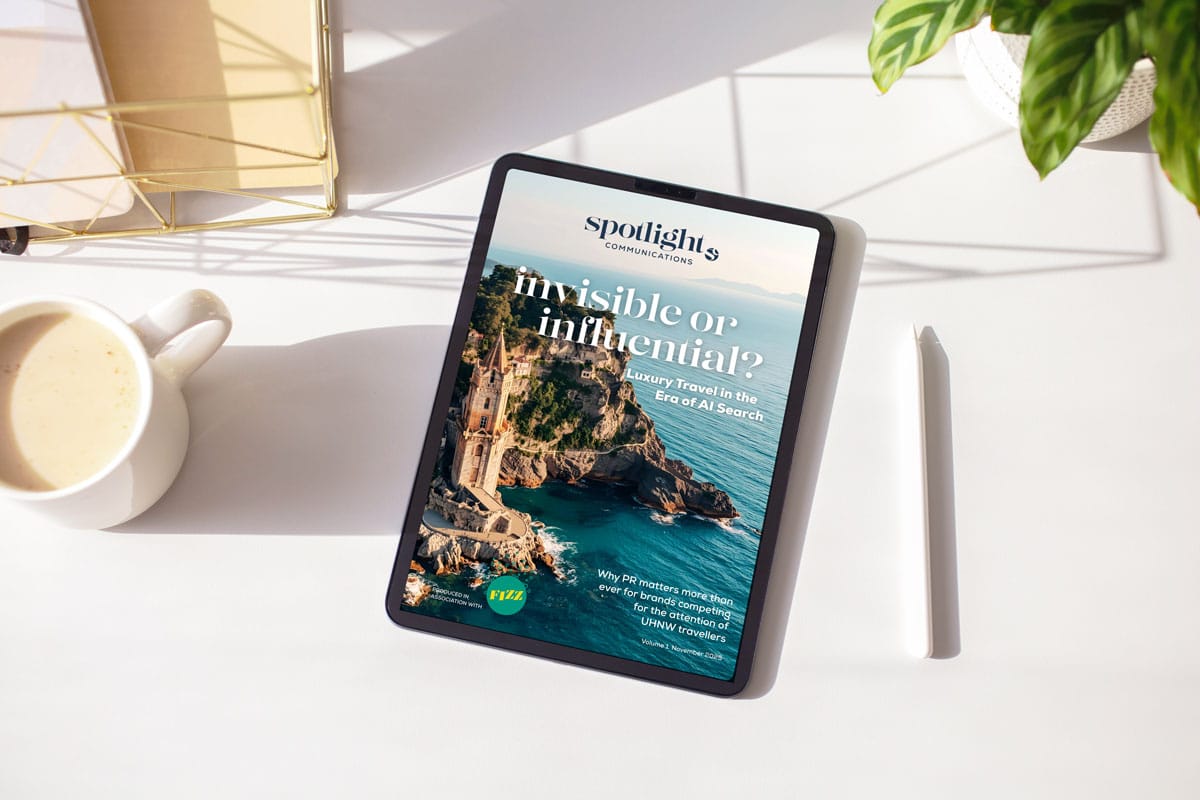

In partnership with Spotlight Communications, we audited 17 luxury hospitality and travel brands for AI visibility — testing how they appeared across ChatGPT, Claude, Perplexity, and Gemini. What we found challenged a lot of assumptions about what it takes to be recommended by AI.
Why We Did This
Luxury brands spend significant budget on PR, editorial placement, and brand-building. The assumption has always been that strong media coverage translates into strong visibility. We wanted to test whether that assumption still holds in the age of AI search — whether the brands with the best editorial reputations were also the brands AI systems were recommending.
The short answer: not always. And the gap between editorial reputation and AI visibility was often significant.
How We Measured It
We assessed each brand across six dimensions: domain authority and backlink profile, AI citation frequency across the four major platforms, content structure and machine readability, topical authority in their core subject area, search visibility, and social amplification. We then tested the same brands across standardised prompts on ChatGPT, Claude, Perplexity, and Gemini — asking the kinds of questions a high-value traveller or booker would actually use.
What We Found
Finding 1: Publication coverage doesn’t automatically translate into AI citations
Several brands in our audit had exceptional editorial coverage — genuine placements in Condé Nast Traveller, Travel + Leisure, and equivalent prestige titles. But those placements weren’t consistently translating into AI recommendations. The reason: some of those publications sit behind paywalls or use JavaScript rendering that limits how well AI systems can crawl and extract their content.
We called this the Paywall Paradox. A feature in The Times carries enormous brand value and genuine authority signals — but if the AI system can’t access the content, it can’t cite it. Brands were earning coverage that wasn’t reaching AI systems at all.
Finding 2: Some of the most prestigious titles are nearly invisible to AI
Related to the above: publications like Centurion and Departures — highly prestigious in luxury travel circles — use JavaScript rendering that creates significant barriers to AI crawling. A brand featured extensively in these titles may have strong human-facing coverage but weak AI citation profiles.
This matters because brands and their PR agencies are often optimising for the wrong metric. Column inches in the right publication still matters enormously for brand building — but AI visibility requires a separate, parallel assessment of which coverage is actually being seen by AI systems.
Finding 3: The publications that matter most to AI are not always the obvious ones
Our citation analysis across the four AI platforms identified a consistent pattern: certain publications were cited repeatedly for luxury travel queries while others — including some household names — rarely appeared. The titles that performed strongly in AI citations tended to have open, well-structured content, strong domain authority, and consistent topical focus on luxury travel.
One consistent finding: Elite Traveler showed the strongest trajectory for future AI citation growth among the publications we assessed. Its content structure, accessibility, and topical authority make it increasingly well-positioned as AI systems update their training data.
Finding 4: Fashion and lifestyle publications punch below their weight
Elle, Vogue, Tatler, Harper’s Bazaar — these titles carry significant weight in luxury brand circles and are common targets for hospitality PR. But our research found they cluster together in AI responses in a way that dilutes their individual authority signal for travel-specific queries. AI systems treat them as a fashion-luxury cluster rather than as individual authoritative sources on travel.
For brands targeting AI visibility in travel and hospitality, coverage in dedicated travel titles consistently outperforms equivalent coverage in fashion or lifestyle publications.
Finding 5: Hub pages and category pages are often invisible
Several brands in our audit had strong individual property pages but weak or absent hub content — the kind of pages that answer broad queries like “luxury hotels in the Dolomites” or “best spa resorts in southern Europe.” AI systems answering those queries need a source that speaks to the category, not just the individual property.
Brands that had invested in well-structured hub or collection pages — clearly defining their properties within a geographic or experiential category — appeared significantly more often in broad discovery queries than those relying solely on individual property pages.
Finding 6: Different AI platforms cite different sources
One of the most practically useful findings: the same brand’s AI visibility can differ significantly across platforms. A brand well-cited by Perplexity might appear far less frequently in Claude or ChatGPT responses — because each platform weights source types differently and draws on different data.
This means AI visibility strategy can’t be built around a single platform. The brands with the most consistent AI presence had built authority signals that worked across multiple source types — editorial coverage, structured on-site content, listing data, and community mentions — rather than concentrating on any single channel.
What This Means in Practice
The audit confirmed something we’d suspected: there is a significant gap between how luxury brands invest in visibility and what actually drives AI recommendation. Most brands are optimising for the world as it was — strong editorial coverage, beautiful brand assets, traditional SEO — without a parallel strategy for AI visibility.
Closing that gap doesn’t require abandoning what’s working. It requires adding a layer of intelligence about which coverage is actually reaching AI systems, which publications carry weight in AI responses for your specific category, and what structural changes to your digital presence would make you more consistently recommended.
That’s exactly what an AI Visibility Snapshot covers — and where the full whitepaper goes much deeper.
Written by
Sara Lemos
Co-founder of Make Lemonade. Sara leads AI visibility strategy and digital intelligence, helping luxury hospitality and travel brands appear in AI-generated recommendations.
View full profileFree Research · Make Lemonade
Read the full research: Invisible or Influential?
The full whitepaper goes deeper into all six dimensions, includes the complete publication analysis, and sets out what brands can do with these findings. Download it free.
Leave a Reply