


The consumer journey used to have a research phase. A deliberate, time-consuming middle stage where potential guests or clients gathered information, compared options, read reviews, visited websites, and gradually narrowed a longlist to a shortlist. That phase hasn’t disappeared. But for a growing number of high-value decisions, it has been collapsed into a single conversation.
What the Research Phase Used to Look Like
The traditional consumer journey had a recognisable shape.
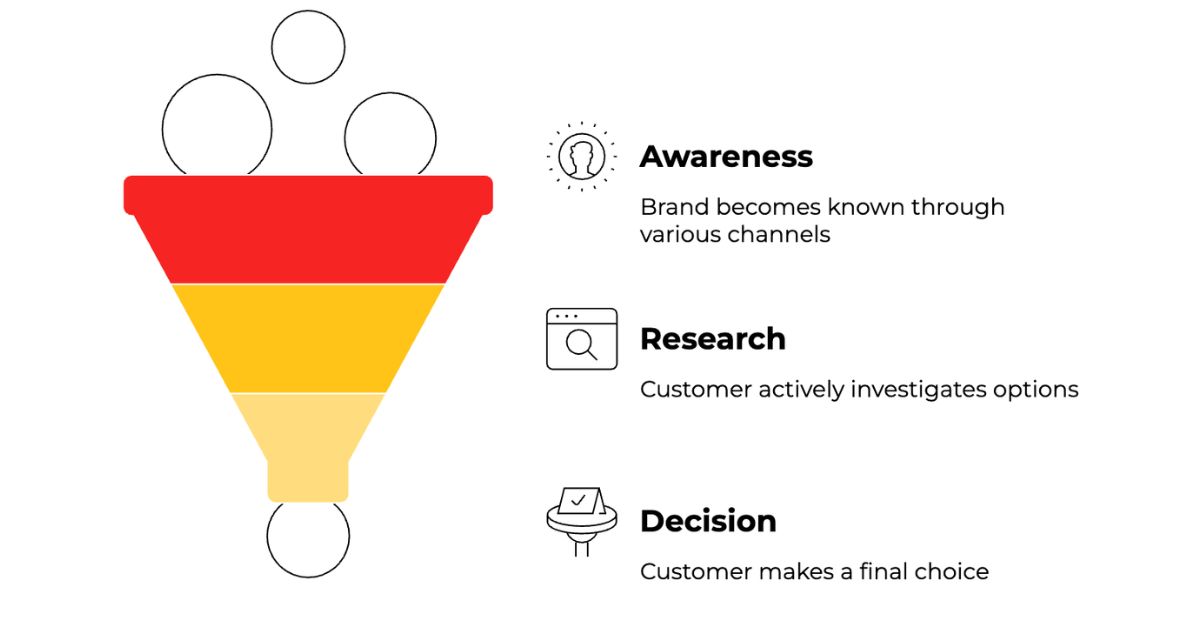
- Awareness — the brand enters consideration through editorial, word of mouth, or advertising.
- Research — the potential customer actively investigates options, visiting multiple websites, reading reviews, comparing features and prices.
- Decision — a shortlist becomes a choice.
The research phase was the longest and most contested part of the journey. It was where brands won or lost. A beautiful website converted visitors who arrived already curious. Strong editorial coverage drove awareness. But the research phase itself — the active comparison and evaluation — happened across multiple sources over days or weeks, and brands had limited ability to influence it directly.
Marketing strategy was built around this model. Funnel thinking. Top of funnel awareness, mid-funnel consideration, bottom-funnel conversion. Each stage required different content, different channels, different metrics.
What LLMs Have Done to That Journey
When a potential guest asks ChatGPT “what’s the best small luxury hotel in Venice for a long weekend anniversary trip, good food, no spa required” — they are not beginning a research phase. They are completing one.
The AI system has done the aggregation, the comparison, the filtering. The response they receive is already a shortlist — often two or three properties, described in context, with the implicit endorsement of having been selected from everything the system knows.
The human hasn’t visited a single website. They haven’t read a review. They haven’t typed anything into a search engine. They’ve had a conversation, and the conversation has produced an answer. For the brands that appear in that answer, the research phase happened without them and ended in their favour. For the brands that don’t appear, the research phase happened without them, and they were screened out before the potential guest ever knew they existed.
This is not a marginal shift. It is a structural change to when and how brands enter the consideration set.
Collapsed, Not Abolished
The more precise framing is not that the research phase has been abolished, but that it has been collapsed and outsourced. The research still happens. Someone is still aggregating information about luxury hotels in Venice, weighing positioning against requirements, assessing credibility, comparing options. That someone is now an AI system, doing it in seconds, invisibly, before the human has made a single deliberate choice.
The consequence is significant. Brands used to have the entire research phase to make their case — through their website, their reviews, their editorial coverage, their presence across booking platforms. Now, in many cases, they have to make their case to an AI system before the human research phase begins. Or more accurately: they have to be legible, credible, and specifically described in the sources AI systems draw from — because that is where the research phase now happens.
What makes a brand visible in that pre-human research phase is different from what makes a brand compelling during a human research phase. A beautiful website converts human visitors. An AI system can’t be converted. It can only be informed — by structured content it can extract, by third-party coverage it can access and trust, by consistent positioning it can categorise, by specific facts it can match to a specific query.
The Brands That Benefit and the Brands That Don’t
The brands best positioned for the collapsed research phase are those with strong AI visibility foundations: clear and specific positioning, structured on-site content, accessible third-party coverage in publications AI systems can actually read, and accurate and consistent data across all platforms. These brands appear in AI responses and arrive at the human stage of the journey already endorsed.
The brands least positioned are often, counterintuitively, the ones with the strongest traditional marketing assets. Beautiful but fact-light websites. Editorial coverage concentrated in prestige publications behind paywalls. Vague, aspirational positioning that reads beautifully to humans but gives AI systems nothing to extract. These brands have invested heavily in the research phase as it used to work. That investment doesn’t transfer automatically to the research phase as it now works.
Our Invisible or Influential research found this pattern consistently across luxury hospitality brands — properties with genuine market reputation that were nevertheless largely absent from AI recommendations, because the signals AI systems use to evaluate credibility weren’t in place. The reputation was real. The AI visibility wasn’t.
What This Means for the Marketing Funnel
The traditional funnel assumed brands could influence each stage. You bought awareness at the top. You won consideration in the middle through better content, better reviews, better website experience. You converted at the bottom.
When the research phase is collapsed by an AI system, the middle of the funnel happens before the brand has any opportunity to influence it. There’s no consideration stage where the human visits your website and you have a chance to make your case. The AI system has already made the shortlist. If you’re on it, you move to the human stage of the journey with significant momentum. If you’re not, you never get the chance.
This reframes where marketing investment needs to go. The traditional mid-funnel — the website, the review management, the comparison content — still matters for the humans who do arrive via AI recommendation and want to confirm their choice. But it needs to be accompanied by a pre-funnel layer: ensuring the brand is visible, credible, and specifically described in the systems that are now running the research phase on behalf of the humans who will eventually become guests or clients.
The Implication for Agencies
For PR and communications agencies, this is one of the more significant structural questions in the discipline right now. The model of earned media as the primary driver of brand consideration was built for a world where humans did the research. Coverage in a prestigious publication reached readers in their research phase and influenced their shortlisting.
When AI systems do the research phase, the question is not whether the coverage exists — it’s whether the AI system can see it. Coverage behind a paywall, in a JavaScript-rendered publication, or in a title that carries human prestige but limited AI citation weight, may not be influencing the AI’s shortlisting at all. The PR is working. The AI just can’t see it.
The agencies that understand this — like Spotlight Communications — and can advise clients on which coverage is reaching AI systems and which isn’t, are the ones positioned to lead the conversation about what PR strategy looks like in the next five years. We work with agencies directly on exactly this, from team education to white-label client services.
Is Any of This Reversible?
Not in any meaningful sense. The direction of travel — towards AI-mediated research, faster shortlisting, less deliberate comparison — is driven by genuine human preference. Time-poor, decision-saturated people would rather ask a system they trust than conduct research themselves. That preference isn’t going to reverse. The AI systems serving it are getting better, not worse.
What is addressable is the gap between a brand’s actual quality and its AI visibility. The two should be the same. For most luxury brands, they aren’t yet. Closing that gap — understanding where you currently stand in AI recommendations, identifying what’s suppressing your visibility, and making the structural changes that move the needle — is the work. It’s not fast. But it compounds. And the brands that start now are building an advantage that becomes progressively harder for later movers to close.
Frequently Asked Questions
Do people really skip the research phase entirely?
Not entirely — but a growing proportion of the research is now done by AI systems before the human gets involved. The human still validates, confirms, and ultimately decides. But the aggregation and initial filtering that used to constitute the research phase is increasingly happening in a single AI conversation. The research phase hasn’t been abolished. It’s been outsourced and compressed.
Does this affect all purchase categories equally?
No. The categories most affected are those where AI responses are trusted for recommendations — hospitality, travel, professional services, high-consideration lifestyle purchases. The effect is strongest where queries are complex and conversational, where the buyer is time-poor, and where the category has enough of an AI training signal to produce confident recommendations. Luxury hospitality sits squarely in all three.
What happens to the brands that don’t appear in AI responses?
They still reach customers through traditional channels — direct search, word of mouth, editorial coverage that humans discover themselves. But they miss the growing proportion of high-intent research that begins and ends in an AI system. And as that proportion grows, so does the commercial cost of absence. The gap between brands with strong AI visibility and brands without it is already measurable. It will get wider.
Where should a brand start?
With an honest baseline. Test how AI systems currently describe and recommend your brand — across ChatGPT, Claude, Perplexity, and Gemini — for the queries your target audience would actually use. Note what appears, what’s missing, and where competitors are appearing instead of you. That baseline is the starting point for everything else. The AI Visibility Roadmap takes it from there.
Make Lemonade
Find out where your brand stands in the research phase that matters now.
The AI Visibility Snapshot gives you a clear picture of how AI systems currently see, interpret, and recommend your brand before your potential guests ever arrive at your website.
Leave a Reply