


There is a commercial transaction taking shape inside AI platforms that the media and advertising industry has barely begun to map. As of February 2026, OpenAI is already testing ads, while Perplexity began experimenting back in late 2024. It involves three parties, generates real commercial value, and sits at the centre of a question that brands, agencies and publishers are all about to have to answer: when AI advertising uses a publication’s credibility as the trust signal, who should get paid for that?
Three Parties, One Payment
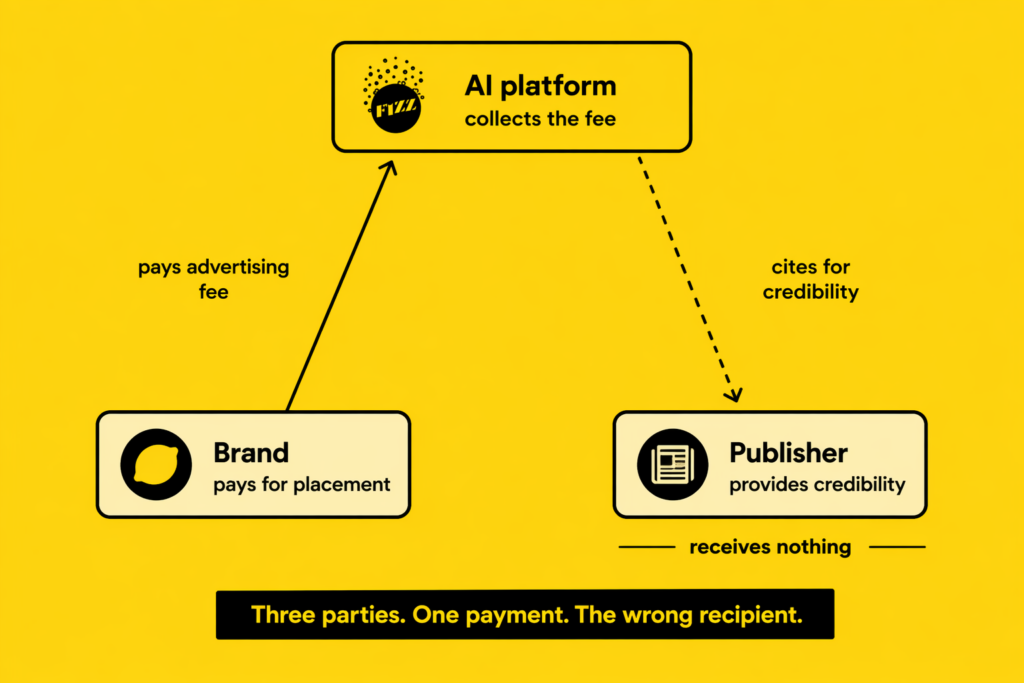
A luxury hotel brand, a travel company, or a consumer goods business pays an AI platform to appear in relevant responses. A user asks ChatGPT or Perplexity for a recommendation. The AI surfaces the brand. To make the recommendation credible, the AI cites a review or article from a respected publication, a piece of journalism from Condé Nast Traveller, say, or a guide from the Financial Times’s How to Spend It. The user trusts the recommendation because of that citation. The brand gets the endorsement. The AI platform collects the fee. The publication that wrote the piece creating the trust in the first place receives nothing.
Three parties. One payment. The wrong recipient.
This is the next layer of a problem we introduced in The Invisible Debt, where we looked at how AI platforms are built on media content and the industry is not being paid for it. That piece examined the basic attribution gap. This one looks at what happens when advertising enters the equation.
Why Citation Is the New Media Placement
For decades, brands understood that media placement was about credibility transfer. A review in Condé Nast Traveller carried value not just because readers saw it, but because the publication’s editorial authority attached itself to the brand. Being recommended by a trusted source was worth more than any amount of paid advertising, because editorial endorsement was something money could not buy directly.
AI citation is doing something structurally identical. When an AI platform recommends a hotel and cites a respected travel publication as the basis for that recommendation, it is transferring the publication’s credibility to the brand. The brand benefits from the association. The editorial authority flows from the publication to the recommendation.
The difference is that in the traditional model, the publication had full control over whether that credibility transfer happened and what form it took. In the AI model, the publication has no say. Its content is retrieved, summarised, and deployed as credibility infrastructure for a commercial transaction it was never part of.
AI citation is doing something structurally identical to editorial endorsement. The publication’s credibility is transferred to the brand. The publication is not in the room when it happens.
What This Means for Brands
Brands operating in AI search need to understand something that most of their agencies have not yet articulated clearly: your visibility in AI responses depends heavily on whether high-authority publications are citing you.
An AI recommendation that comes with no editorial backing is a flat assertion. An AI recommendation that cites a respected source is a credible one. Users feel that difference, even if they cannot name it. The citation is the trust signal. And the trust signal comes from journalism, not from the brand’s own content.
This means that PR, which has always been about placing brands in editorial contexts, is now doing something more structural than it ever has before. A review placed in a title with strong AI citation authority does not just reach that publication’s audience. It enters the AI ecosystem as retrievable credibility, available to be deployed in AI responses for months or years after publication.
The implication is that the value of media relations work is higher than brands currently account for, and that the quality of the publication matters more than ever: not just for the readers it reaches directly, but for the AI citation weight it carries.
What This Means for PR Agencies
PR agencies are in an interesting position in this dynamic. They have always been the intermediaries between brands and editorial coverage. They know which titles carry authority, which journalists are influential, and how to position a brand story for maximum placement impact.
None of that expertise has become less valuable in the AI era. In some respects, it has become more valuable, because the AI platforms are doing exactly what a good PR agency does: assessing source credibility, weighing editorial authority, and deciding which voices to trust. The difference is that the AI is doing this at scale and in real time, which means that a placement in the right title can now have a multiplied effect that extends far beyond the article’s original readership.
The agencies that will thrive are those that understand this dynamic and can articulate it to clients. Not just “we got you coverage in this title” but “that coverage is now retrievable by AI platforms as a trust signal, and here is its citation authority score.” That framing transforms the metric for a placement from page views to something more durable and arguably more valuable.
But it also raises a question that agencies have not yet had to answer: if you are pitching coverage in a specific title partly because of its AI citation authority, and that authority is itself built on the publication’s credibility, are you advising clients to build their reputations on a foundation the publication controls and the AI platform exploits?
The Ghost in the AI Advertising Transaction
What makes this dynamic uncomfortable is not the individual injustice to any one publication. It is the structural logic it reveals about where value sits in the AI advertising economy.
Brands pay for AI placement. AI platforms collect that revenue. The editorial credibility that makes the placement worth paying for comes from journalism. Journalism is funded by advertising and subscription revenue. AI platforms are reducing both, by diverting user attention away from the publication and toward the AI answer. The cycle is self-defeating: AI advertising extracts value from the media ecosystem it depends on, while simultaneously degrading the conditions that allow that ecosystem to produce credible content.
This is not a niche concern for media industry insiders. It is a structural problem for any brand whose long-term reputation depends on being recommended by sources people trust. If the publications that create that trust cannot sustain their business models, the trust infrastructure that makes AI recommendations meaningful will eventually hollow out.
In the previous piece in this series, we looked at whether AI platforms should be paying publications for live citation at all, and what models could make that work. The ghost in this transaction is the same entity: the publication whose credibility underwrites the whole commercial arrangement, invisibly, for free.
AI advertising extracts value from the media ecosystem it depends on while degrading the conditions that allow that ecosystem to keep producing credible content.
The Question Brands Should Be Asking
Right now, most brands are asking their agencies: how do we get cited in AI responses? That is the right question for the short term. But the more strategically important question is: which publications are carrying enough AI citation authority to make coverage in them meaningful, and how is that authority changing over time?
A brand that invests in media relations with high-citation-authority titles is building something durable. A brand that chases volume coverage across low-authority sources may see short-term AI mentions with no lasting weight behind them.
The publication in the middle of every AI recommendation is not a passive conduit. It is the reason the recommendation has any value at all. The brands and agencies that recognise this earliest will make better decisions about where to focus their media investment, and why.
In the final piece in this series, we ask what a functional attribution model could actually look like — and what it would mean for how brands buy media.

Written by
Sara Lemos
Co-founder of Make Lemonade. Sara leads AI visibility strategy and digital intelligence, helping luxury hospitality and travel brands appear in AI-generated recommendations.
View full profilePrevious article
Should AI Platforms Pay Publications to Cite Them?Next article
What Attribution Modelling Could Actually Look Like