


Every time an AI platform answers a question from someone asking about where to stay, what to book, or how to buy, it pulls the answer from some form of online content.
This could be a review site like Tripadvisor, a blog post, or a carefully written article – each representing journalism that took time to research and edit. The editorial authority that makes the answer credible, aside from brand sites, reviews, and OTAs, is the content pulled from media publications. But that publication almost certainly did not get what it created the content for: traffic to its site. It is an AI media attribution problem that nobody has solved as yet.
This is not the training data debate, which has been in legal discussions between media companies and AI businesses for years. This is something more immediate. What happens every single day, across millions of queries, when AI cites a publication’s work to back up its answer, and the publication gets no traffic, no revenue, and no signal it was even used?
Maria at Make Lemonade recently spoke to editors and content directors at some of the UK’s most respected luxury travel titles. The same question was put to each of them: do you know whether AI platforms are citing your work?
Most didn’t know. One described it as finding out someone had been using photographs without credit. A larger-scale taking of content seen as licensed and owned, which needs a much bigger discussion.
What AI Citation Actually Does to a Publication’s Value
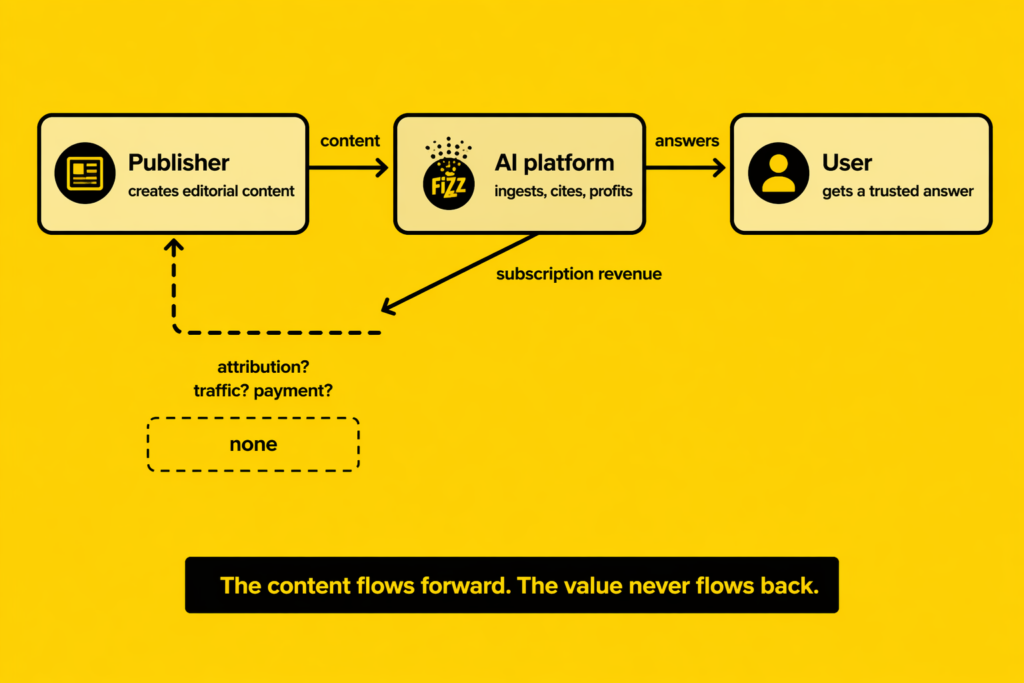
If you ask ChatGPT which hotel to book in Venice, the response is not a list of articles to read. It is a combined generated answer with a recommendation, shaped around traveller type and experience, sometimes with a source listed at the end. That source is generally a publication and its editorial credibility is what makes the recommendation trustworthy. This shift is already collapsing the traditional consumer research phase for high-value travel decisions.
AI bot activity increased 225% across the web during 2025. TollBit research found scrapers retrieving full versions of paywalled articles without permission. The plagiarism fear among publishers is real, and the lack of clear attribution equally so. ChatGPT drives less than 0.2% of referral traffic back to the publishers it draws from, according to Raptive data across 6,000 independent titles. The more AI platforms take, the less they return.
One publishing executive put it plainly in a recent Digiday piece: “The irony is all these AI companies are paying for the content and data. They’re just not paying the publishers.”
This is not just about a lost publishing partnership fee. It is about someone profiting from work they did not do, invisibly, at a scale the original creator cannot track.
The Attribution Signal Your Brand Might Be Missing
There is a related problem that affects brands directly. And it is about what AI can and cannot see.
Brands invest in editorial coverage partly because association with trusted publications builds credibility over time. That logic used to be straightforward. But AI does not read mastheads. It reads structural signals, topical signals, and authority signals that have nothing to do with editorial stature.
The research Make Lemonade and Spotlight Communications are working on for the upcoming whitepaper found a striking example of this. A supplement produced by one of Britain’s most trusted newspapers, same editorial team, same standards, scored significantly lower in AI citation authority than the parent title. Not because the journalism was different. Because the attribution signals that AI reads were not there in the same way. The content existed and the credibility existed, but the AI simply could not connect them.
For brands, this has a direct commercial implication. Coverage in a publication that AI does not recognise as authoritative for a specific query does not contribute to AI discoverability, regardless of whether the title has a strong reputation or high circulation. The brand invested in media exposure, but that did not translate into AI visibility.
AI does not read mastheads. It reads signals. And right now, most brands and their PR agencies have no visibility into what those signals are.
The AI Media Attribution Gap Nobody Has Priced Yet
It gets more interesting when advertising enters the picture.
Perplexity is already selling sponsored placements inside AI responses. OpenAI has quietly launched its ads manager. Their pitch to brands is simple: pay, and your name appears at or near the top of the answer. Which sounds straightforward until you look at where the answer gets its credibility.
A sponsored hotel recommendation in an AI response is not trusted because the AI said so. It is trusted because the AI has absorbed years of editorial opinion from publications that travellers trust. The brand paid for access to that trust. The platform collected the revenue. The publications whose journalism built the trust are outside the transaction entirely.
| Who does what | Who gets paid |
|---|---|
| Publication builds editorial authority over years | The publication is not paid for any AI citation it is used in |
| AI platform trains on and cites that content | The AI platform benefits by collecting ad revenue from brands |
| Brand pays for sponsored placement in AI responses | The sponsored content is a recommendation backed by editorial credibility |
| User reads AI recommendation and books | Journey ends in the AI interface |
The entity that created the underlying value is the only one not in the transaction. This is the attribution gap publishers need to be talking about more. The next piece in this series looks at whether AI platforms should be paying for live citation — and what models could actually make that work.
Where This Sits Right Now
The media industry is still largely having the training data conversation. The citation question is newer, less defined legally, and AI platforms have no particular incentive to move quickly on it. Most publications are still figuring out how to measure their own citation authority, let alone negotiate around it.
Some have resorted to blocking AI bots entirely, however the data suggests it makes little difference. Around 75% of sites that block AI crawlers still appear in AI citations, which tells its own story about how much control publishers actually have right now.
The programmatic advertising market took a decade to consolidate into structures that were largely unfavourable to publishers. The conditions for AI attribution are forming now. The publications, agencies, and brands that understand what is actually happening at a data level are the ones best placed to shape what those structures look like. An AI Visibility Snapshot is a practical starting point for any brand that wants to understand where it currently stands.
That is what the whitepaper research with Spotlight has been building towards. We explore what a working attribution model could actually look like in the final piece in this series. Stay tuned for the full whitepaper findings, releasing in June.
Coming in June: Invisible or Influential: How Leading Travel and Luxury Publications Are Adapting to AI
In partnership with Spotlight Communications, Make Lemonade has measured AI citation authority across 30 UK luxury travel publications, testing which titles AI platforms actually trust, which are invisible despite their reach, and what that means for brands, agencies, and the media industry.
The findings are more surprising than expected.
Register your interest to receive the whitepaper once it launches.
Make Lemonade is a boutique AI search optimisation consultancy specialising in luxury hospitality and travel brands. This article is the first in a series exploring AI citation, media attribution, and the emerging citation economy. The Signal Noir Whitepaper 2, Invisible or Influential: How Leading Travel and Luxury Publications Are Adapting to AI, produced in partnership with Spotlight Communications, publishes June 2026.
Frequently Asked Questions
What is the AI media attribution problem?
When AI platforms cite media content in their responses, the publication that created that content receives no traffic, no revenue, and no measurable credit. The value of their editorial authority is being used commercially, without any of that value returning to the source.
Should AI platforms pay publications for citing them?
It depends on the nature of the citation. Where AI substitutes for the original content so thoroughly that the user never needs to visit the source, there is a strong case for compensation. Where AI is functioning more like a reference, the model is closer to how media has always cited other sources. We explore this question in full in the next article in this series.
What is citation-based media investment?
An emerging approach where brands invest in content strategies designed to increase their AI citation authority within trusted publications, rather than buying individual placements. The investment moves upstream from single articles to the relationships and structural signals that make AI recommendation more likely over time.
How does AI advertising affect media attribution?
When brands pay AI platforms for sponsored recommendations, those recommendations draw credibility from the media sources the AI cites. The publication whose content makes the recommendation trustworthy receives no share of that advertising spend. That is the core of the attribution gap in the emerging AI advertising economy. We cover this in detail in part three of this series.
What is AI citation authority?
AI citation authority is the measurable likelihood that a publication will be referenced by an AI platform such as ChatGPT, Claude, Perplexity, or Gemini when answering queries relevant to a specific sector or topic. It is distinct from domain authority, circulation, and organic search rankings, and does not appear to be predicted by any of them.
Written by
Sara Lemos
Co-founder of Make Lemonade. Sara leads AI visibility strategy and digital intelligence, helping luxury hospitality and travel brands appear in AI-generated recommendations.
View full profileNext article
Should AI Platforms Pay Publications to Cite Them?