


Sara Lemos explains the difference between AI mentions, citations and sources, and why luxury travel brands and the agencies that represent them now need to understand all three.
Related reading: Editorial Coverage Has Become a Distribution Channel.

As AI platforms reshaped how luxury travel brands get discovered, the industry reached for a new vocabulary: mentions, citations, sources.
The terms appear in research reports, agency briefings and platform dashboards, often used interchangeably. AI mentions, citations and sources are not the same thing. The differences between them now determine whether a brand is recommended, referenced or ignored.
Key statistics
33/100
average AI visibility score across 17 audited luxury hotel properties in the US. Most appeared in fewer than four out of ten relevant AI responses
262
citations generated by commercial blogs and specialist content sites across four AI platforms, compared with 156 from premium editorial publications
49%
of ChatGPT luxury travel citations came from traditional editorial publishers, the highest of any platform analysed. Perplexity attributed 78% to commercial blogs
2x
higher AI visibility for brands with frequent, high-quality PR coverage compared with comparable peers with solid websites but limited editorial presence
Sources: Invisible or Influential? Volume 1 (November 2025) and Volume 2 (June 2026), Make Lemonade and Spotlight Communications
What an AI mention is
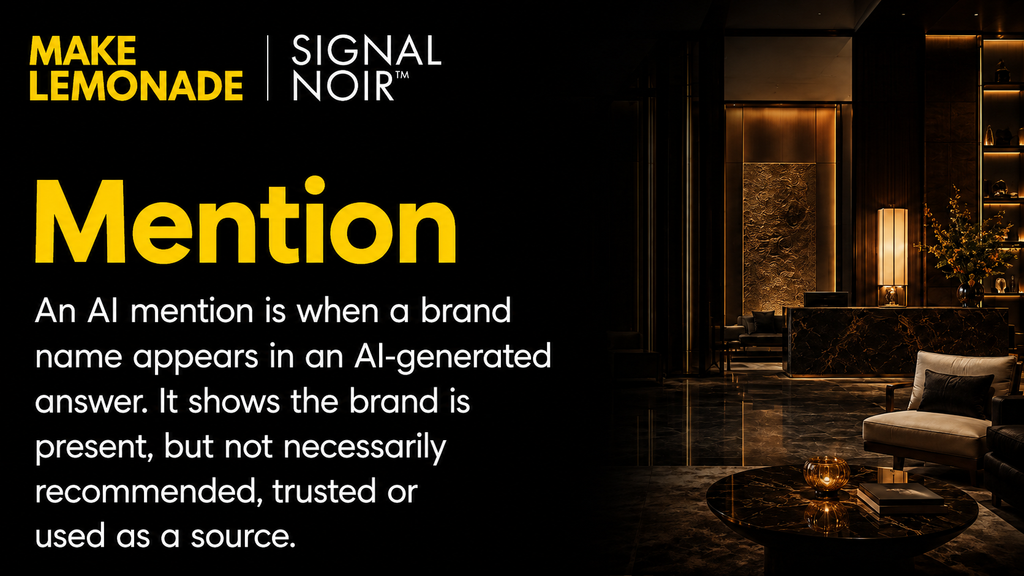
A mention is the broadest of the three terms. It means a brand name appears somewhere in an AI-generated response. The brand exists in the answer. That is all a mention confirms.
Mentions matter because they are countable and comparable. The Invisible or Influential? Volume 1 research tracked total mentions across AI prompts as a measure of how often each audited property entered AI-generated conversations at all.
The average across 17 luxury hotel properties was approximately 1,370 mentions, but the distribution was uneven. We found a small number of high-visibility brands generated thousands, while roughly half recorded fewer than 300.
A mention can be positive, neutral, vague or contradictory. It can appear in a list where the brand is acknowledged rather than recommended. It does not tell you whether the platform trusts the brand, understands it accurately or would choose it for a specific traveller query. Being mentioned is the floor, not the ceiling.
What an AI citation is
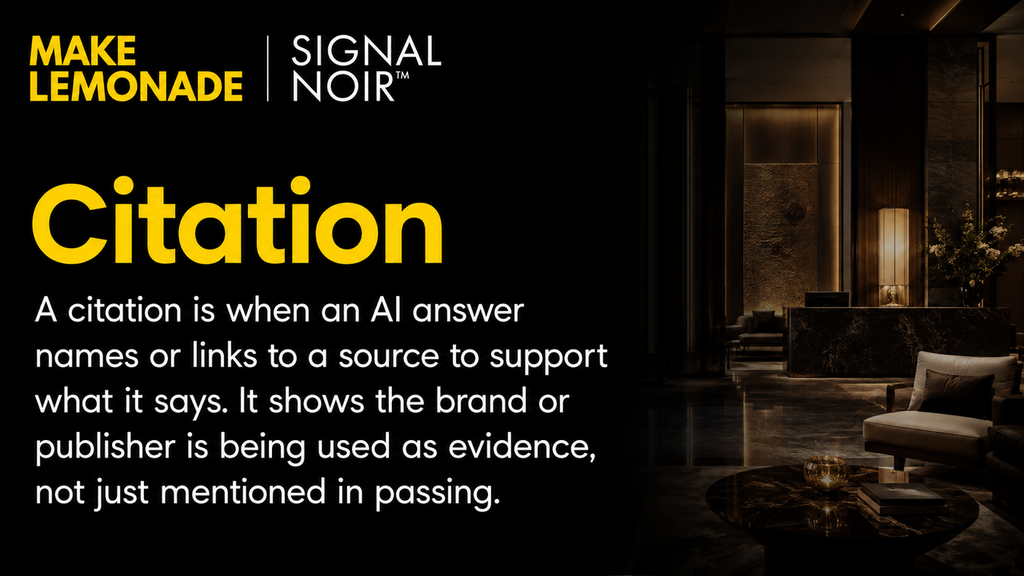
A citation is more specific. It means an AI platform has attributed a piece of information to a source. This could be a publication, a website, a review platform or a data provider. When ChatGPT says “according to Condé Nast Traveller”, or Perplexity lists its sources at the end of a response, those are citations. The system is not just repeating information, it is acknowledging where that information came from.
Citations are where the gap between human and algorithmic judgement becomes visible. The Invisible or Influential? Volume 2 research analysed 30 luxury travel and lifestyle publications across four AI platforms and found that commercial blogs and specialist content sites generated 262 citations, compared with 156 from premium editorial publications. That is not a reflection of editorial quality. It is a consequence of the kinds of content AI platforms can most easily process, extract and reuse.
“In many cases, highly respected publications are being outranked not because they are less trusted, but because their journalism is harder for AI systems to interpret.”
Lucy Clifton, CEO, Spotlight Communications. Invisible or Influential? Volume 2, June 2026
Citation behaviour varies by platform. ChatGPT aligns most closely with traditional editorial authority, attributing 49% of its luxury travel citations to editorial publishers. Perplexity leans towards commercially structured content, with 78% of citations going to commercial blogs and specialist sites. Claude has the broadest range, regularly surfacing OTAs, Wikipedia and aggregators alongside editorial media. Gemini rewards clarity and readability over prestige alone. A brand cited by ChatGPT may be invisible on Perplexity, not because it is less credible but because its content is not structured in a way that Perplexity’s retrieval system rewards.
What an AI source is
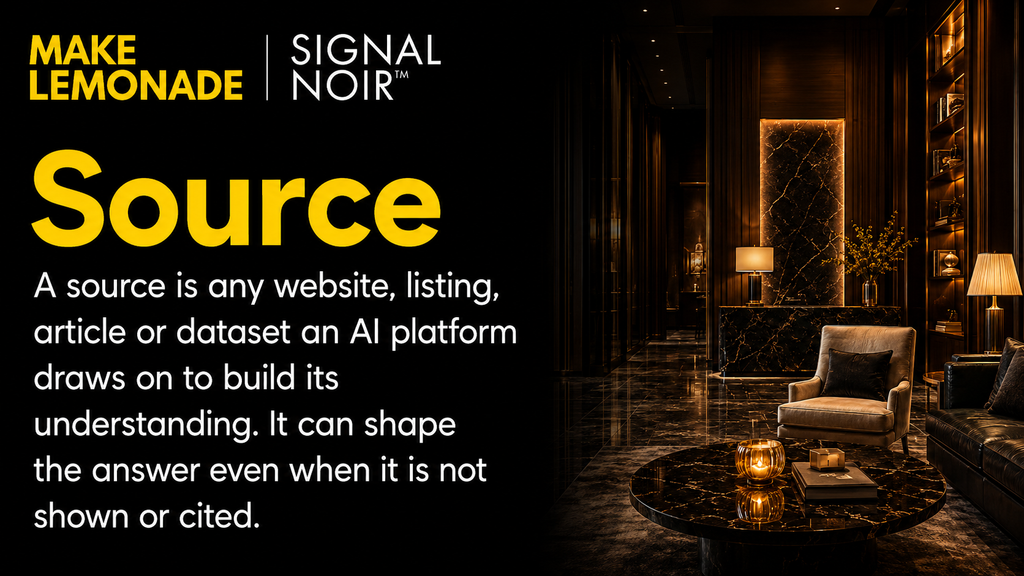
A source is what an AI platform draws on to build its understanding of a brand, destination or category. Sources are not always visible in the response. A platform may cite Condé Nast Traveller explicitly when naming a hotel, but the underlying source pool that shaped its understanding of the luxury travel category is far broader. It is gathering from OTA listings, brand websites, Wikipedia entries, review aggregators, archived editorial, licensing agreements and training data. The source layer is where AI authority is built, and it is largely invisible to the brand being recommended.
It is also where the technical fundamentals still apply. Google’s guidance for site owners explains that a page must be indexed and eligible to appear with a snippet before it can be shown as a supporting link in AI Overviews or AI Mode.
The Invisible or Influential? Volume 1 research found that domain authority and referring domains were more reliable predictors of AI visibility than technical website performance alone. One property scored 85% on AI technical readiness but achieved only 14 out of 100 for AI visibility. This was because the source signals pointing to it were insufficient. Another, with poor mobile performance scores, achieved 59 to 65 out of 100, supported by 16,800 referring domains and over one million monthly visitors. The source ecosystem, not the website, determined the outcome.
Why AI mentions, citations and sources matter for PR agencies
Not all coverage does the same work in AI environments. A placement generates a mention if the brand name appears. It generates a citation if the content is structured, accessible and specific enough for AI systems to extract and attribute. It builds source authority if the publication itself is one that AI platforms consistently draw on when forming answers about that destination or category.
The Volume 1 research found that brands with frequent, high-quality PR coverage showed up to twice the AI visibility of comparable peers with solid websites but limited editorial presence. Volume 2 adds a critical nuance: the publications generating the most citations are not always the most prestigious. Condé Nast Traveller ranked first overall in the Volume 2 publication audit, combining editorial authority with highly structured editorial architecture and a direct licensing relationship with OpenAI. Robb Report ranked third despite a comparatively closed publishing model, because its long-form reviews and clearly framed recommendations create content AI systems can interpret and reuse. The Luxury Travel Expert and similar specialist sites generated more AI citations than many larger lifestyle titles, because their content is built around explicit recommendations rather than narrative authority.
The implication is not to abandon prestige titles. It is to understand which placements are doing which job, and to ensure the coverage earned is structured in a way that travels beyond the human reader.
What AI mentions, citations and sources mean for hotel brands
For a hotel or destination, the three terms map to three commercial outcomes. A mention means the brand exists in AI conversations. A citation means the brand’s information is being used to inform those conversations. Source authority means the brand is part of the underlying infrastructure AI platforms draw on when answering questions about its category, destination or traveller type.
Most luxury hotels are operating at the mention level, if they appear at all. Volume 1 found average AI visibility scores of approximately 33 out of 100 in the US and 28 out of 100 in the UK, with most properties appearing in fewer than four out of ten relevant AI responses. Only three exceeded 50 out of 100: Fairmont, Dorchester Collection and Corinthia Hotels, all established international brands with significant media presence and thousands of referring domains.
Moving from mention to citation requires structured, specific, machine-readable content. Moving from citation to source authority requires sustained editorial presence, entity recognition across the web and, in some cases, direct relationships with the platforms themselves through licensing or data partnerships.
How SIGNAL NOIR™ measures AI mentions, citations and sources
Understanding where a brand sits across AI mentions, citations and sources requires a different kind of audit from traditional media monitoring. SIGNAL NOIR™ is Make Lemonade’s proprietary framework for assessing how a brand is structured, interpreted and cited within AI-driven environments. It was the primary methodology for both volumes of the Invisible or Influential? research programme, and examines not just whether a brand appears in AI responses, but how prominently it is cited, which platforms are surfacing it, which sources are contributing to its authority, and where the gaps sit between current performance and recommendation-level visibility.
Without that distinction, brands optimise for the wrong thing: chasing mention volume when the real work is in citation quality and source infrastructure.
Find out whether your brand is being mentioned, cited or ignored.
We run SIGNAL NOIR™ audits for luxury travel brands, destinations and PR agencies. Get in touch to discuss what an audit would cover for your brand or client portfolio.
Frequently asked questions
What is the difference between AI mentions, citations and sources?
A mention means a brand name appears in an AI-generated response. A citation means a platform has attributed specific information to a named source. A source is anything a platform draws on to build its understanding of a brand, whether or not it is credited in the answer. Citations carry more commercial weight than mentions, and source authority carries more than either.
What is an AI source and how is it different from a citation?
A source is what an AI platform draws on to build its understanding of a brand or category, including content it does not explicitly cite. Sources include OTA listings, brand websites, editorial archives, Wikipedia entries, review aggregators and licensing agreements. Building source authority means becoming part of the underlying infrastructure AI systems rely on, which is a deeper form of influence than citation alone.
Do all AI platforms cite the same sources?
No. ChatGPT shows the strongest alignment with traditional editorial publishers, attributing 49% of luxury travel citations to editorial media. Perplexity attributed 78% of citations to commercial blogs and specialist content sites. Claude has the broadest citation range, regularly surfacing OTAs and aggregators alongside editorial media. A brand may be cited frequently on one platform and barely appear on another.
Why do some prestigious publications generate fewer AI citations than smaller specialist sites?
Because AI citation is driven by content structure and accessibility, not editorial prestige alone. Respected publications are sometimes outranked by smaller specialist sites because their journalism is harder for AI systems to parse, attribute and reuse. JavaScript-rendered sites, paywalled content without licensing agreements, and narrative-led writing without explicit factual anchors all reduce citability regardless of editorial quality.
How does SIGNAL NOIR™ measure AI mentions, citations and sources?
SIGNAL NOIR™ is Make Lemonade’s proprietary framework for assessing how a brand is structured, interpreted and cited within AI-driven environments. It examines mention frequency, citation quality, platform variation and source authority across ChatGPT, Claude, Perplexity, Gemini and Google AI Overviews, producing a structured picture of where a brand sits across all three levels and what would move it toward recommendation-level visibility.
How can a PR agency improve a client’s AI citation rate?
By targeting publications that AI platforms consistently draw on for the relevant destination and category, ensuring coverage is specific, factually anchored and structurally citable rather than purely narrative-led, and building the brand’s entity signals across the web so AI systems have a consistent picture to draw on. The Invisible or Influential? research found that brands with frequent, high-quality PR coverage showed up to twice the AI visibility of comparable brands with limited editorial presence.
Sources: Invisible or Influential? Volume 1, Spotlight Communications and Make Lemonade, November 2025; Invisible or Influential? Volume 2, Make Lemonade and Spotlight Communications, June 2026.
Written by
Sara Lemos
Co-founder of Make Lemonade. Sara leads AI visibility strategy and digital intelligence, helping luxury hospitality and travel brands appear in AI-generated recommendations.
View full profile