


Related reading: Editorial Coverage Has Become a Distribution Channel and AI Mentions, Citations and Sources: What Is the Difference?
Sara Lemos analyses what August 2026 actually means for luxury and independent hospitality brands as AI platforms move from recommending hotels to booking them.

August was the month the gap between “AI mentions you” and “AI books you” narrowed to almost nothing, and then held. The plumbing that lets an AI agent complete a transaction rather than simply describe one is now live. But the businesses closest to pressing go on the actual payment button keep choosing not to. For luxury and independent hospitality brands, that hesitation is worth understanding before the market moves past it.
August 2026: key developments
7 Aug
Google confirmed to Skift that agentic hotel booking is live in a limited US test inside AI Mode, with Booking Holdings, Expedia, Marriott, Wyndham and IHG among the first partners
10 Aug
Yelp, OpenTable and Resy launched live restaurant booking inside ChatGPT, allowing a diner to move from recommendation to confirmed reservation without leaving the conversation
9%
of consumers are open to fully autonomous purchasing by AI, according to Accenture’s Consumer Pulse research across 25,590 people in 16 countries. Payments remain the biggest barrier
58.4%
of AI hotel recommendation links for luxury travellers go to independent hotels, not chains, according to analysis of 245,046 AI-cited sources across 19,579 runs
Sources: Skift; Yelp; Accenture; Nicolas Sitter
What actually launched in August
On 7 August, Google confirmed to Skift that agentic hotel booking is live in a limited US test inside AI Mode. A traveller describes a trip, the AI compares hotels, and the reservation is completed inside the conversation. Booking Holdings CEO Glenn Fogel confirmed on an earnings call the same week that his company is among the first partners, alongside Expedia, Marriott, Wyndham and IHG. Three days later, Yelp announced live restaurant booking inside ChatGPT, with OpenTable and Resy offering the same capability simultaneously. A diner can now go from asking for a recommendation to holding a table without leaving the conversation.
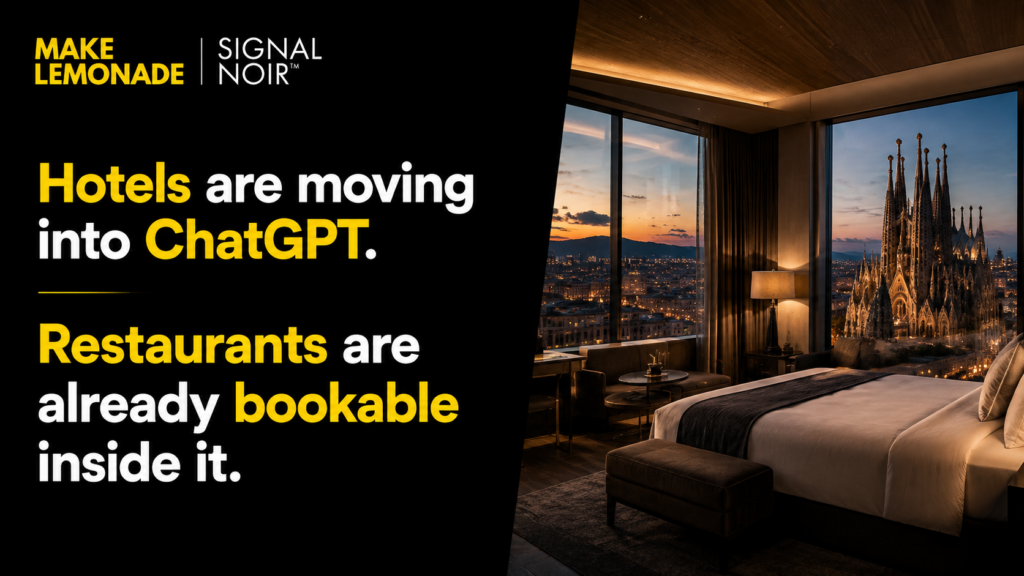
Read together, these two announcements confirm that the infrastructure enabling AI agents to complete transactions, not just describe them, is now live. But a quieter story runs alongside the headlines: nobody has actually built the payment button at scale, and the businesses closest to doing it keep choosing not to. Radisson and Motel 6 both launched ChatGPT apps in late July that return the guest to their own website to pay. OpenAI itself moved its Instant Checkout feature out of core ChatGPT earlier this year after travellers abandoned the flow at the point of payment.
The data explains why. Accenture’s 2026 Consumer Pulse Research, covering 25,590 consumers across 16 countries, found that while 74% would trust a personal AI agent to handle routine tasks including deal negotiation, only 9% are open to fully autonomous purchasing, and only 12% are comfortable with AI making purchase decisions at the payment stage. As Accenture’s own report states, payments remain the biggest barrier. The rails are built. The passengers are not yet ready to board without a human conductor.
What this means for independent properties
The practical read for a boutique hotel, spa or wellness retreat is not that AI booking is imminent. It is that the infrastructure being built this month connects chains and OTAs first. Amadeus has described itself as the first infrastructure partner wired into Google’s new booking protocol. Sabre’s CEO has stated that Google does discovery well but does not yet do booking or servicing, and could be handed that capability quickly. Neither of those pipes has a lane reserved for a single-property brand with no distribution deal.
That distinction decides something concrete: who the guest belongs to once a booking completes. A stay routed through an AI-to-OTA path may not carry the same guest data or direct relationship as one booked through a property’s own site. For a property that depends on repeat guests and a direct line to them, that is not a technical detail — it is the business model.
“Every direct guest is a brand asset. Every OTA guest is a rented relationship.”
Invisible or Influential? Volume 1, Spotlight Communications and Make Lemonade, November 2025
Why luxury is, for now, the exception
There is an encouraging data point buried in a large independent study. Researcher Nicolas Sitter analysed 245,046 unique sources across 19,579 AI runs, covering six AI models (including GPT 5.1, GPT 5.2, Gemini Flash 2.5, Perplexity Sonar, Grok-3 and Grok-4) recommending hotels to eight traveller personas across 25 cities. Cut by traveller type, luxury travellers saw 58.4% of AI hotel recommendation links going to independent hotels, against 32.3% chain and just 9.3% OTA. Compare that with group business travellers, who received 45.1% chain links, or 3-star properties, which saw 28.8% OTA links and only 18.7% chain.
AI models are not defaulting to big-brand safety for luxury the way they do for business or budget travel. That is a real, measurable advantage for boutique and independent properties right now. The same study also found that hotels with strong fundamentals, an optimised Google Business Profile, consistent positive reviews and authoritative brand presence across multiple sources, tended to hold top positions in 98% of queries for their local market.
It is not a permanent advantage, however. Two developments from August show the volatility. Search Engine Land reported that Reddit’s share of ChatGPT Search citations fell 86.4% in four days, from 3.83% to 0.52%, beginning on 14 August, with no explanation from OpenAI. The tracking firm Promptwatch could date the shift precisely but could not explain it. Separately, a study by The Happy Cat put ten fixed buyer questions to ChatGPT, Perplexity and Gemini and logged 104 different cited sources across just 30 answers, with only three recommended by all three platforms. Each platform is selecting sources by a different logic, and that logic can shift without warning.
The AI review summary problem for wellness brands
There is a related issue worth flagging for wellness and spa properties specifically. UK consumer body Which? found in August that Tripadvisor’s AI-generated review summaries were, in some cases, downplaying serious guest concerns including hygiene complaints. Tripadvisor disputes the finding and points to its safeguards, but the underlying risk is structural: a summary flattens exactly the differentiation a luxury or wellness guest is choosing on. A property cannot control the AI summary. It can control what feeds it: current, verified and specific reviews that give AI systems something accurate and granular to work with.
Two things worth doing now
The evidence from August is that the platforms with the most reason to build a payment button keep stopping short of it. That pause is unlikely to last. In the meantime, the advantage the data shows luxury and independent brands holding is real but fragile. Two actions have an outsize return relative to their cost:
- Audit which distribution pipes carry your property and how accurate the data in them is. An AI agent completing a transaction on stale or inconsistent amenity data is a worse outcome than one that simply mentions you. OTA listings, Google Business Profile, structured data on the brand site and any third-party editorial coverage all need to say the same thing about the same property.
- Check your AI citation footprint regularly, not once. The Reddit citation collapse happened over four days with no warning. A property that monitored its AI presence monthly would have missed it entirely. The ground moved several times this month alone, on more than one platform, without notice. Being visible today is not the same as staying visible next month.
How SIGNAL NOIR™ tracks this in real time
Understanding where a property stands across AI recommendation, citation and source authority requires monitoring that runs at platform speed, not campaign speed. SIGNAL NOIR™ tracks how a brand is recommended, cited and recognised across ChatGPT, Claude, Perplexity, Gemini and Google AI Overviews, so that shifts like the Reddit citation collapse surface as data rather than surprises, and so that the advantage independent luxury properties currently hold can be measured, maintained and built on rather than assumed.
Find out where your property stands in AI-generated recommendations.
We run SIGNAL NOIR™ audits and technical SEO reviews for luxury travel brands, destinations and the agencies that represent them. Get in touch to discuss next steps.
Frequently asked questions
Is AI hotel booking live now?
In limited form, yes. Google confirmed to Skift on 7 August 2026 that agentic hotel booking is live in a limited US test inside AI Mode, with Booking Holdings, Expedia, Marriott, Wyndham and IHG among the first partners. Most experiences currently hand the traveller off to a partner site to complete payment rather than processing the transaction inside the AI interface.
Can ChatGPT book restaurants now?
Yes. On 10 August 2026, Yelp, OpenTable and Resy all launched live booking inside ChatGPT, allowing users in the US and Canada to book a table or join a waitlist without leaving the conversation. Changes or cancellations must be managed directly through the partner platform.
Are consumers ready for AI to complete hotel bookings autonomously?
Not yet, according to Accenture’s 2026 Consumer Pulse Research. Only 9% of the 25,590 consumers surveyed across 16 countries are open to fully autonomous purchasing by an AI agent, and only 12% are comfortable with AI making purchase decisions at the payment stage. The research identifies payments as the biggest barrier to agentic commerce adoption.
Do independent luxury hotels perform better than chains in AI recommendations?
For luxury travellers, at least in current data. Nicolas Sitter’s AI Hotel Landscape 2026 study, covering 245,046 AI-cited sources across 19,579 runs, found that 58.4% of AI hotel recommendation links for luxury travellers went to independent hotels, against 32.3% chain and 9.3% OTA. This pattern does not hold for business or budget travel, where chains dominate. Hotels with consistent reviews, a strong local presence and a clear category position performed most stably.
What does the Reddit citation collapse mean for hotel brands?
It means that AI platform source selection can shift significantly and without warning. Reddit’s share of ChatGPT Search citations fell 86.4% in four days in August 2026, from 3.83% to 0.52%, with no explanation from OpenAI. For hotel brands, the practical implication is that AI visibility needs to be monitored continuously rather than audited once, and that relying on any single source or platform for recommendation share carries structural risk.
Sources: Google Confirms Agentic Hotel Booking Is Now in Testing, Skift; Yelp Brings Reservations and Waitlist to ChatGPT, Yelp Blog; OpenAI’s Shift Shows Travel Is Too Complex for Quick-Fix Distribution, PhocusWire; Two Hotel Groups Moved Into ChatGPT This Week. Neither Will Let You Pay There, The Next Web; Talk to My AI Agent, Accenture Consumer Pulse Research 2026; AI Hotel Landscape 2026, Nicolas Sitter; Reddit’s ChatGPT Search Citations Fell 86% in Four Days, Search Engine Land; ChatGPT, Perplexity and Gemini Cited 104 Sources in 30 Answers, Pressat; The Challenge of Keeping AI-Generated Travel Review Summaries Accurate, PhocusWire; Invisible or Influential? Volume 1, Spotlight Communications and Make Lemonade, November 2025.
Written by
Sara Lemos
Co-founder of Make Lemonade. Sara leads AI visibility strategy and digital intelligence, helping luxury hospitality and travel brands appear in AI-generated recommendations.
View full profilePrevious article
AI Mentions vs Citations: What’s the Difference?