


Every PR campaign ends with a report. It usually shows you the coverage secured, reach achieved and Impressions delivered. For years, those numbers have been the language of media value.
They are still useful. But they are no longer enough. For luxury travel and hospitality brands specifically, they may now be missing the metric that matters most: whether AI saw the coverage too.
In What Is AI Authority? we set out the four-stage hierarchy that now governs AI-led discovery: visibility, authority, recommendation and commercial impact. This article goes one level deeper into the first of those stages, measurement, and looks specifically at why citation share is becoming the metric that matters more than the ones PR teams have reported on for years.
AI platforms are now sitting between publications and their audiences. When a UHNW traveller opens ChatGPT and asks for the best small luxury hotels in Japan, they are not browsing twelve publications and forming their own shortlist. They are receiving a pre-filtered recommendation shaped entirely by what the AI system has already decided to trust.
The question is no longer how many people saw your coverage. It is whether AI saw it too.
How PR Measurement Was Built for a Different Era
The metrics used to evaluate media performance were designed for a world where audiences moved from publication to reader in a straight line. A feature ran. People read it. Some became customers. Reach and impressions were proxies for that journey.
That model is fracturing. The publications appearing in an AI-generated answer are not necessarily the ones with the highest circulation or the strongest domain authority. They are the ones whose content AI can read, interpret and confidently cite. As our research found, some of the most respected titles in luxury travel barely surface at all, not because of poor journalism, but because of structural barriers AI cannot see past.
Your coverage in a title with zero AI citation value is invisible to the system now sitting between that title and your audience.
The New Metric: Citation Share
Our research for Invisible or Influential?, published in June 2026 with Spotlight Communications, tested 30 leading luxury travel and lifestyle publications across ChatGPT, Claude, Gemini and Perplexity. The findings reframe what media value looks like.
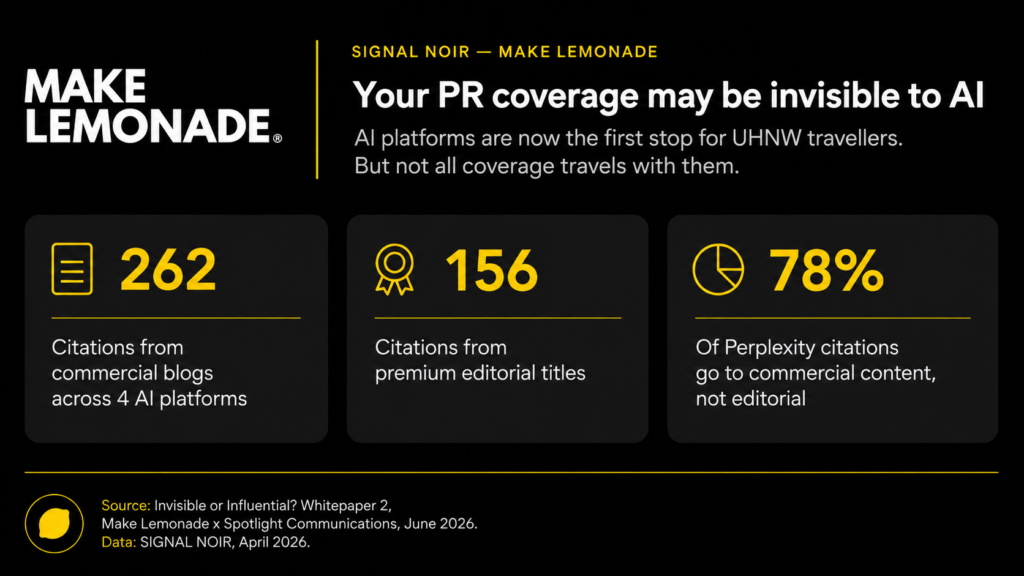
Across all four platforms, commercial blogs and specialist content sites generated 262 AI citations. Premium editorial publications generated 156. This is not a reflection of quality. It is a reflection of structure. AI platforms cite what they can read. They ignore what they cannot, regardless of how respected the source is.
More significantly for brands: sponsored content, advertorial and brand-authored copy generated zero citations across every publication audited. Not low citations. Zero. The formats most commonly bought as commercial placements are the exact formats AI does not cite.
What the Metrics Look Like Side by Side
Traditional PR measurement tracks what reached people. AI authority measurement tracks what reached the systems now influencing people.
| Traditional PR Measurement | AI Authority Measurement |
|---|---|
| Impressions and reach | Citation frequency across AI platforms |
| Domain authority (SEO) | Entity authority in AI training and retrieval |
| Coverage volume | Coverage in AI-cited source publications |
| Traffic from media links | Inclusion in AI-generated answers |
| Share of voice (media) | Citation share (AI engines) |
Why This Matters for Luxury Hospitality Specifically
The UHNW traveller is not a high-volume, low-intent searcher. They are deliberate, research-led and increasingly using AI to shortlist options before they engage with an advisor, a brand website or a booking platform.
Paul Croughton, Editor in Chief of Elite Traveler, captured it clearly in our research: the HNW audience is increasingly using AI to plan trips. Previously they would go to editorial, get inspired, then go to a travel adviser to book. Now people are going straight to AI to create itineraries.
If your brand does not appear in those AI-generated itineraries, you are absent from the consideration set before the guest ever picks up the phone. No amount of impressive coverage metrics changes that.
Luxury hotel brands do not win at the point of booking. They win in the AI recommendations that shape it.
Make Lemonade, Signal Noir™ Framework
What Citation Share Actually Measures
Citation share is the percentage of AI-generated responses in a defined query set that include a reference to your brand, either directly or through publications covering you. It is measured across platforms, query types and persona types, because different AI systems behave very differently.
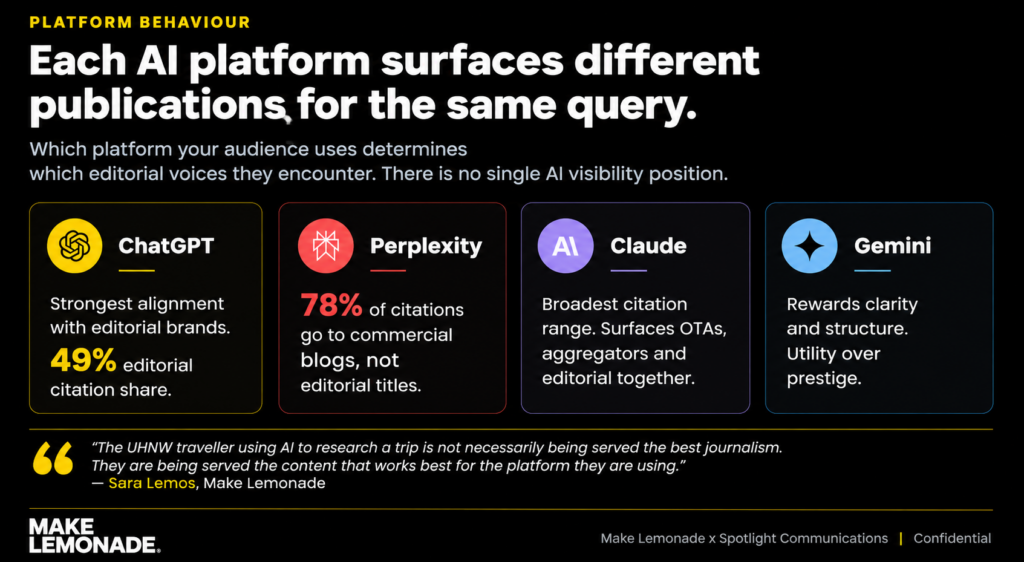
ChatGPT shows the strongest alignment with established editorial brands. Perplexity directs 78% of its citations to commercial content rather than editorial. Claude has the broadest citation range, surfacing OTAs, aggregators and editorial together. Gemini rewards clarity and structure over prestige.
There is no single AI position. A brand that appears consistently on ChatGPT may be absent from Perplexity. A publication with strong citation authority on one platform may carry no weight on another. This fragmentation is why citation share needs to be measured across platforms, not assumed from any single source. It is also why SIGNAL NOIR™ tests across all four simultaneously.
What Brands Can Do About It
The brands building AI authority right now are not replacing their PR strategies. They are adding an intelligence layer on top of them, the same measure, build, monetise structure set out in the SIGNAL NOIR™ framework.
That means understanding which publications in their media plan carry real AI citation weight. It means briefing for editorial formats that AI systems can cite, not just formats that generate reach. It means knowing which queries their brand appears in across each platform, and which competitor brands are displacing them.
It also means being honest about what current PR reporting does not show. A coverage report that lists impressions and reach without any reference to AI citation share is now an incomplete picture of media performance.
The value of media can no longer be assessed solely through audience reach, circulation or brand alignment. Visibility is no longer simply about placement. It is about whether the placement can travel.
Invisible or Influential? Volume 2, June 2026
The Brief for Brands in 2026
The industry is at an early inflection point. Most luxury travel brands are still measuring media performance the way they did five years ago. The brands that move first on AI authority measurement will have a significant and compounding advantage: every month of citation data creates a baseline against which future performance can be measured.
The question is not whether AI is reshaping how UHNW travellers discover and shortlist luxury travel brands. It already is. The question is whether your brand has a strategy for it.
This is the second article in the AI Authority for Brands series by Make Lemonade. Start with What Is AI Authority? for the foundational framework, or read the full research in Invisible or Influential? Volume 2, produced in partnership with Spotlight Communications.
Find out where your brand stands in AI recommendations.
A SIGNAL NOIR™ audit maps your brand across all four AI platforms and identifies exactly where citation share is being created, lost or left unclaimed.
Frequently Asked Questions
What is AI authority for a luxury travel or hospitality brand?
AI authority is the strength of the signals that influence whether a brand is cited and recommended by AI systems like ChatGPT, Claude, Perplexity or Gemini. It depends on editorial citation patterns, structured content and consistent brand data, not on circulation or reputation alone. See What Is AI Authority? for the full framework.
What is citation share?
Citation share is the percentage of AI-generated responses in a defined query set that reference a brand, either directly or through the publications covering it. It is measured across platforms, since ChatGPT, Claude, Perplexity and Gemini each cite differently for the same query.
Why does sponsored content get zero AI citations?
AI systems are trained to recognise and weight editorial authority. Sponsored content, advertorial and brand-authored copy lack the structural and contextual signals AI uses to assess credibility, so they are excluded from citation regardless of where they are published.
How is AI authority measurement different from traditional PR reporting?
Traditional PR reporting measures impressions, reach and coverage volume. AI authority measurement tracks citation frequency, entity authority and inclusion in AI-generated answers, the signals that actually determine whether a brand appears in an AI recommendation.
How can a brand measure its current AI citation position?
A SIGNAL NOIR™ audit tests a brand’s citation position across ChatGPT, Claude, Perplexity and Gemini using personas and queries configured around its specific guest types and competitor set, producing a clear, comparable view of where AI authority is being built or lost.

Written by
Sara Lemos
Co-founder of Make Lemonade. Sara leads AI visibility strategy and digital intelligence, helping luxury hospitality and travel brands appear in AI-generated recommendations.
View full profilePrevious article
What Is AI Authority? The Next Evolution of AI Search VisibilityRead the research
Invisible or Influential? Volume 2