


What is AI authority?
AI authority is the set of signals that determine whether AI systems such as ChatGPT, Claude, Perplexity and Google AI Overviews trust, recognise and recommend a brand, publisher or destination. It sits above visibility in the hierarchy of AI influence: visibility asks whether AI can find you, authority asks whether AI trusts you enough to recommend you.
It is the next evolution of AI search visibility, and the stage at which commercial outcomes are decided.
In the AI search era, marketing teams have been hearing terms such as AI visibility, GEO, AEO and AI search optimisation, all attempting to answer the same question: how does a brand show up in AI-generated responses? But visibility alone does not explain why some brands are recommended, some publishers are cited, and some organisations are ignored. This article introduces AI authority, the four-stage hierarchy that connects visibility to commercial impact, and the original research programme conducted across 4 AI platforms that underpins the Make Lemonade SIGNAL NOIR™ framework.
From visibility to authority: the next stage of AI discovery
The first wave of AI search thinking produced a cluster of overlapping terms: AI visibility, Generative Engine Optimisation (GEO), Answer Engine Optimisation (AEO) and AI search optimisation. Each emerged in response to a real shift in consumer search behaviour. In 2024, Gartner predicted that traditional search engine volume would decline by 25% by 2026 as users increasingly turn to AI chatbots and virtual agents for answers. As Gartner analyst Alan Antin noted:
“Generative AI solutions are becoming substitute answer engines.”
These frameworks help organisations understand how AI systems discover, retrieve and present information. A full explanation of these approaches can be found in What is Generative Engine Optimisation?
Much of the conversation has focused on visibility: whether content can be found, surfaced and cited by AI systems. Visibility explains how content enters consideration. It does not fully explain why, among thousands of potential sources, certain brands, publishers and destinations are consistently named and recommended while others are not. That is where the conversation begins to evolve, and where AI authority takes over.
The four stages of AI influence
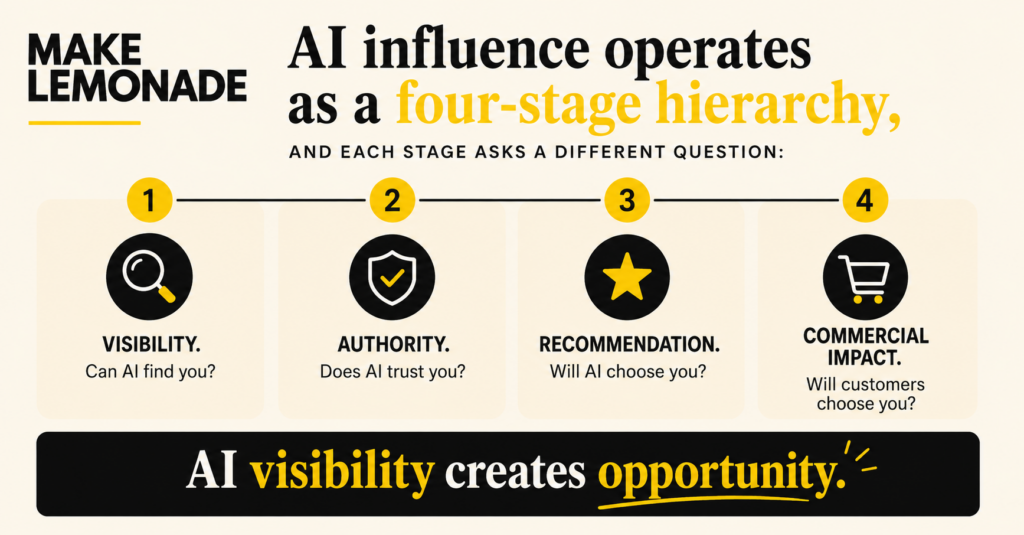
AI influence operates as a four-stage hierarchy. Each stage asks a different question, and the commercial value concentrates in the final two:
- Visibility. Can AI find you?
- Authority. Does AI trust you?
- Recommendation. Will AI choose you?
- Commercial impact. Will customers choose you?
AI visibility creates opportunity. Authority creates recommendation. Recommendation creates commercial value. Most organisations are still optimising for stage one while the commercial outcomes are decided at stages two and three.
The behavioural data shows why this matters. Pew Research Center found that users who encounter an AI Overview click a traditional search result only 8% of the time, compared with 15% when no AI summary appears. When the answer is the destination, being chosen inside the answer is the only position that converts.
The authority layer: connecting PR, SEO and AI
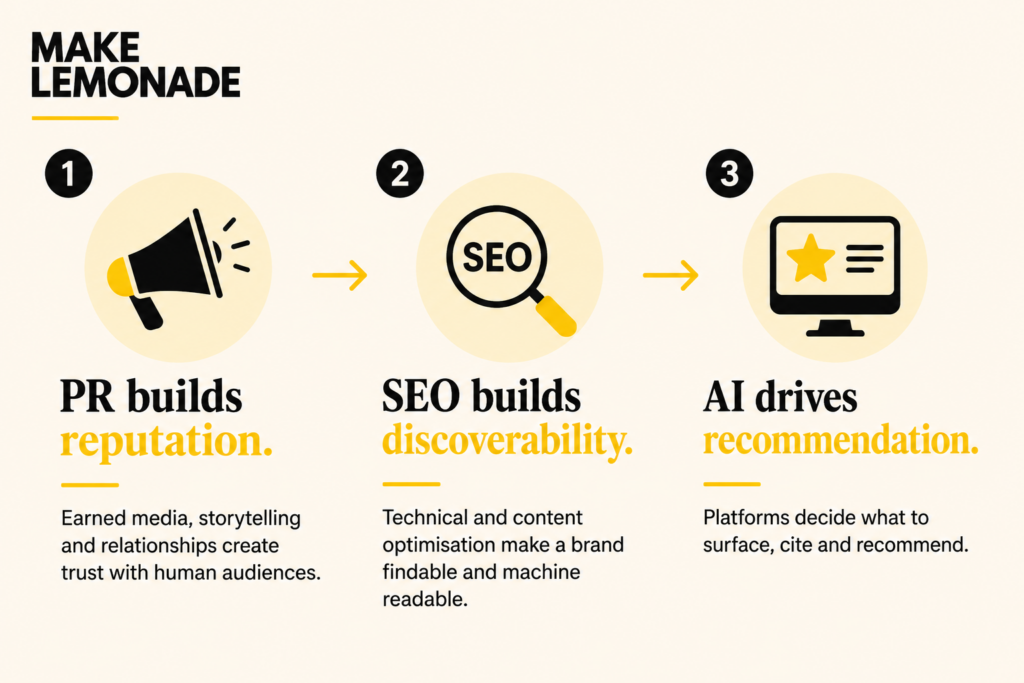
Three established disciplines each carry part of the load:
- PR builds reputation. Earned media, storytelling and relationships create trust with human audiences.
- SEO builds discoverability. Technical and content optimisation make a brand findable and machine readable.
- AI drives recommendation. Platforms decide what to surface, cite and recommend.
Authority is the connective layer between reputation, discoverability and recommendation. Reputation earned in print does not automatically become a signal an AI system can read. Discoverability does not automatically become a recommendation. The work of authority building for AI search is translation: making sure the trust a brand has earned is recognised by the systems now shaping discovery.
The academic evidence supports this. Research from Princeton University and Georgia Tech, published at ACM KDD 2024, found that strengthening credibility signals such as citations, quotations and statistics can boost visibility by up to 40% in generative engine responses. AI systems reward content they can trust and verify, not simply content they can find.
Not PR. Not SEO. The authority layer.
PR helps brands earn authority. SEO helps brands demonstrate authority. AI decides which authority gets surfaced. Make Lemonade works across all three to ensure that authority is recognised: not replacing a PR agency, an SEO team or a content strategy, but making certain the authority they create translates into AI recommendation.
The research: Invisible or Influential?
If AI is becoming a recommendation layer, the question is no longer whether authority matters, but how AI recognises it.
In November 2025, we began investigating that question through original research.
Invisible or Influential? is an ongoing research programme exploring two connected questions: how brands become recommended, and how publishers become cited. The research spans luxury hospitality brands, travel publishers, communications agencies and leading AI platforms.
Study one: Invisible or Influential? Luxury Travel in the Era of AI Search
An audit of how luxury hospitality brands perform in AI-generated recommendations, co-authored with Spotlight Communications. The study covers:

- 15 luxury brands
- 17 bespoke audits
- 4 AI platforms: ChatGPT, Claude, Perplexity and Google AI Overviews
Study two: The Publications That AI Cite
An analysis of how luxury travel and lifestyle media perform as AI sources, built on the SIGNAL NOIR™ framework. The study covers:

- 30 publications analysed
- 1,400+ citations measured
- 8 senior editors interviewed
- 4 AI platforms: ChatGPT, Claude, Perplexity and Google AI Overviews
The headline finding from the first two Invisible or Influential? white papers;
“AI is not simply changing search. It is changing how authority is recognised, attributed and recommended.”
Invisible or Influential?, Make Lemonade research
The SIGNAL NOIR™ framework: measure, build, monetise
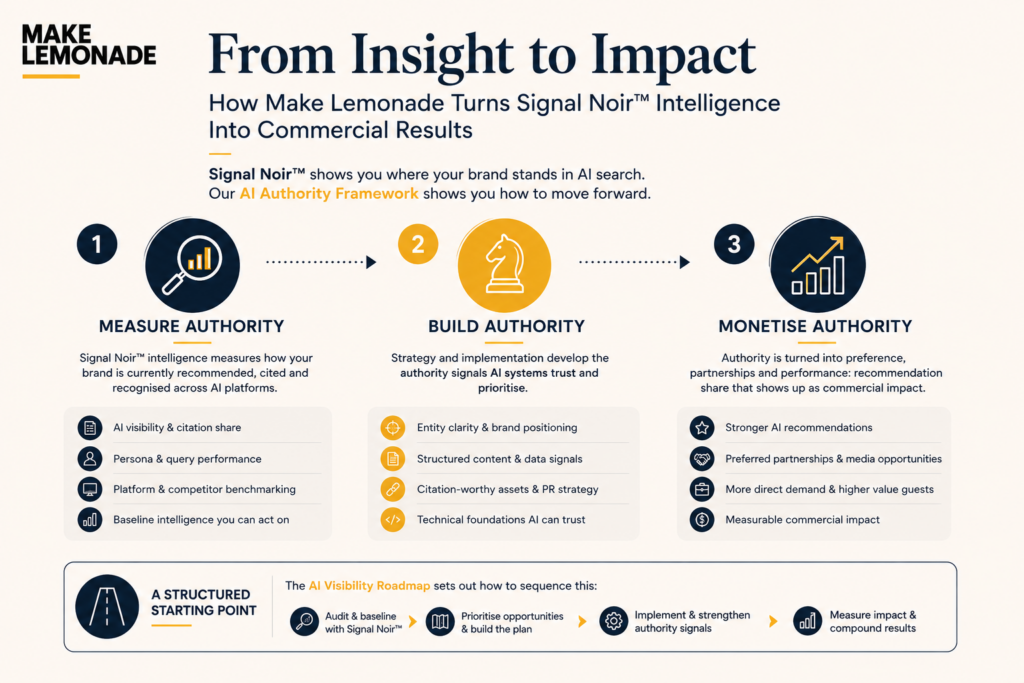
The SIGNAL NOIR™ framework converts research into practice in three stages:
- Measure authority. SIGNAL NOIR™ intelligence measures how a brand is currently recommended, cited and recognised across AI platforms, establishing the baseline.
- Build authority. Strategy and implementation develop the authority signals AI systems trust and prioritise: entity clarity, structured content and citation-worthy assets.
- Monetise authority. Authority is turned into preference, partnerships and performance: recommendation share that shows up as commercial impact.
For a structured starting point, the AI Visibility Roadmap sets out how to sequence this work.
Citations and references
- Gartner (2024). Gartner Predicts Search Engine Volume Will Drop 25% by 2026, Due to AI Chatbots and Other Virtual Agents.
- Aggarwal, P., Murahari, V., Rajpurohit, T. et al. (2024). GEO: Generative Engine Optimization. Proceedings of the 30th ACM SIGKDD Conference (KDD 2024).
- Pew Research Center (2025). Google users are less likely to click on links when an AI summary appears in the results. Analysis of 68,879 Google searches by 900 US adults, March 2025.
- Make Lemonade and Spotlight Communications (2026). Invisible or Influential? research programme: Luxury Travel in the Era of AI Search and The Travel Titles AI Reads.
FAQs about AI authority
What is AI authority?
AI authority is the set of signals that determine whether AI systems such as ChatGPT, Claude, Perplexity and Google AI Overviews trust, recognise and recommend a brand, publisher or destination. It operates as the second stage in a four-stage hierarchy of AI influence: visibility (can AI find you?), authority (does AI trust you?), recommendation (will AI choose you?) and commercial impact (will customers choose you?). Authority is the stage that connects discoverability to recommendation, and recommendation to commercial value.
How is AI authority different from GEO or AEO?
GEO (Generative Engine Optimisation) and AEO (Answer Engine Optimisation) describe the mechanics of making content discoverable and citable in AI-generated answers. AI authority describes the outcome those mechanics serve: being trusted enough to be chosen when AI systems generate a recommendation. A brand can be visible and citable without ever being recommended. Discoverability without authority produces presence without commercial impact.
Why does AI authority matter commercially?
Because AI platforms answer rather than list. When users receive a direct AI recommendation, only the named brands compete for the booking or enquiry. Pew Research Center found that users who encounter an AI Overview click a traditional search result only 8% of the time, compared with 15% when no AI summary appears. The hierarchy runs visibility, authority, recommendation, commercial impact, and the commercial value is concentrated in the final two stages. Brands that earn authority at stage two are the ones that convert at stage four.
What research supports the AI authority approach?
Two sources: original research and independent academic evidence. The Invisible or Influential? programme covers 15 luxury brands across 17 bespoke audits on 4 AI platforms (co-authored with Spotlight Communications), and a media study covering 30 publications, 1,400+ measured citations and interviews with 8 senior editors. Independently, research from Princeton University and Georgia Tech, published at ACM KDD 2024, found that strengthening credibility signals such as citations, quotations and statistics can boost visibility in generative engine responses by up to 40%.
What is the SIGNAL NOIR™ framework?
A three-stage methodology developed by Make Lemonade to convert AI authority into commercial performance. Stage one: measure how a brand is recommended, cited and recognised across AI platforms. Stage two: build the authority signals those platforms trust, including entity clarity, structured content and citation-worthy assets. Stage three: monetise that authority as recommendation share and measurable commercial performance.

Written by
Sara Lemos
Co-founder of Make Lemonade. Sara leads AI visibility strategy and digital intelligence, helping luxury hospitality and travel brands appear in AI-generated recommendations.
View full profileRead the research
Invisible or Influential? Volume 2Next Article
Citations Matter More Than Clicks