


The publishers winning visibility in AI search are not writing different stories. They are presenting information in ways that make those stories easier for AI systems to understand, extract and cite. The challenge is not replacing narrative journalism. It is adding enough structure for AI to understand why the content matters.
Most editorial writers would open this same article like this:
There was a time when you could tell a great travel publication by the quality of its prose. Now, a different question is keeping editors up at night: if a reader never reaches the article at all because an AI summarised it first, does the writing even matter? The answer, it turns out, is yes. But the way you frame it has to change.
Both approaches are right. They are just solving different problems. The first helps AI systems find and cite your content. The second is what makes readers trust the recommendation when they get there. The publishers that perform best in AI search are doing both at once.
The Misconception About AI-Friendly Content
When people hear “AI optimisation”, they often imagine content written for machines rather than humans. Pages packed with keywords, industry jargon, endless FAQs. Robotic sounding articles designed to rank rather than engage.
That is not what AI systems look for to use as a citation piece.
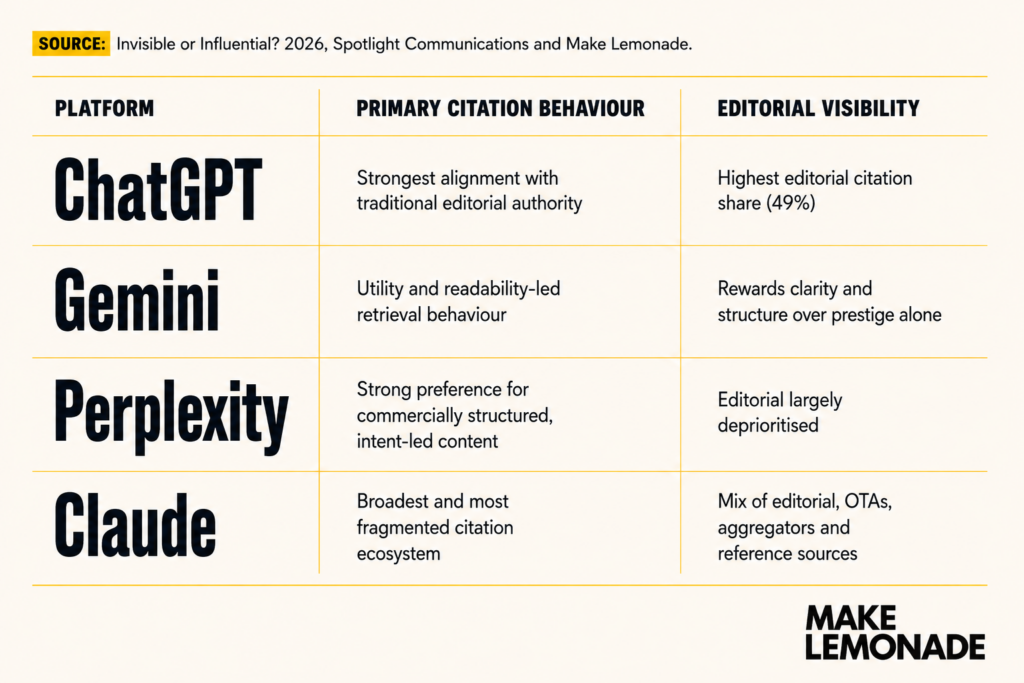
Platforms like ChatGPT, Gemini and Perplexity are increasingly surfacing trusted editorial sources that provide clear answers, recommendations, expertise and evidence. Articles that provide a point of view and difference. The opportunity for publishers is not to become technology publications, it is to make existing editorial content easier to interpret. Understanding how each platform weights and cites sources is covered in depth in the Invisible or Influential? whitepaper, a 30-publication study into how leading travel and luxury titles are adapting to AI search.
“AI still can’t quite replicate voice and in an ideal world human experience will continue to be prioritised over machine recommendations in travel.”
Claire Irvin, Head of Travel, The Times
What the Problem Actually Looks Like
The problem is not the quality of the writing. It is that too much excellent editorial content buries its most useful information inside narrative structure, making it difficult for AI systems to identify key facts, recommendations and entities.
A travel writer’s account of arriving at a remote lodge in Patagonia. An interiors editor’s perspective on a designer’s latest collection. A food critic’s assessment of a newly opened restaurant. These are the moments that create authority and trust. But if the piece has no clear structure around it, an AI system scanning for a recommendation may simply pass it over. This is what the research behind AI media attribution calls the invisible debt: coverage that earns no citation credit because the source cannot be parsed at query time.
What Doing Both Looks Like in Practice
The most successful approach combines editorial storytelling with a structural layer that makes the content extractable. Here is what that looks like for a piece on this exact topic:
AI Search and Editorial Publishing: What Publishers Need to Know
What this covers: How AI search platforms surface editorial content, and what structural changes improve citation rates without changing editorial voice.
Who it is for: Editors, heads of content and digital directors at travel and lifestyle publications.
Key takeaway: Structure and storytelling are not in competition. The publishers winning in AI search are doing both.
There was a time when you could tell a great travel publication by the quality of its prose. Now, a different question is keeping editors up at night: if a reader never reaches the article at all because an AI summarised it first, does the writing even matter? The answer, it turns out, is yes. But the way you frame it has to change.
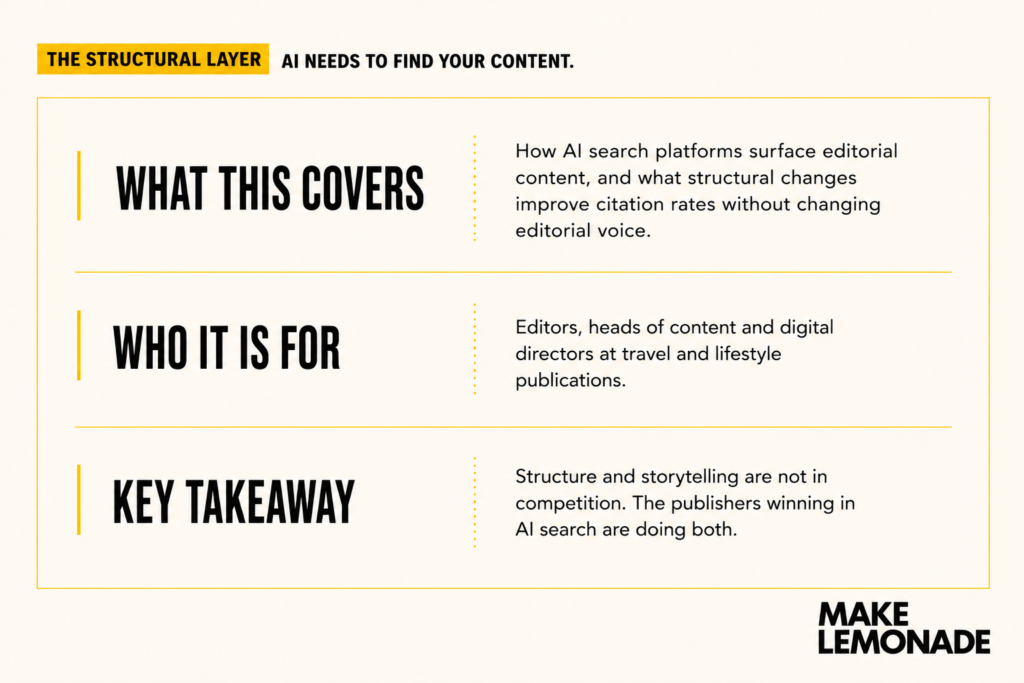
The editorial voice is unchanged. The three structured lines at the top are what allow an AI system to identify the topic, the audience and the core argument and cite the piece when someone asks how editorial publishers should approach AI search.
The Structural Elements That Make the Biggest Difference
Publishers do not need to start writing about AI. They need to look at how existing topics are being formatted. The highest-impact changes are also the least disruptive. For a practical framework on how to apply these, the Make Lemonade guide to generative engine optimisation sets out the core principles:
- A short summary paragraph at the top of each article that states the subject, the recommendation and the audience
- Descriptive H2 headings that reflect what each section actually covers
- Named entities called out clearly: hotel names, destinations, designers, price points
- “Best For” or category callouts within reviews and roundups
- Comparison tables where the content naturally supports them
None of this requires rewriting existing copy. It is a structural layer that sits alongside the editorial voice, not in place of it. The Make Lemonade AI Visibility Roadmap applies this same structural approach to earned media strategies for luxury travel and hospitality brands.
The Recommendation Queries Publishers Are Missing
One of the clearest patterns emerging from AI search is the value of recommendation-driven content. Users no longer search only for information. They ask:
- What is the best luxury hotel in Lake Como?
- Which country house hotel is best for families?
- Where should I stay in the Cotswolds?
AI systems need sources that help answer those questions. Publishers are uniquely positioned to provide those answers because they already have editorial expertise, trusted brands and specialist knowledge. The question is whether the content is structured in a way that makes that expertise visible at query time. Research into which travel publications ChatGPT and Perplexity actually cite shows that prestige alone does not determine citation share. Structural accessibility does.
The publishers that succeed will not be those who abandon storytelling. They will be those who make great storytelling easier to find.
Frequently Asked Questions About AI Search Visibility for Editorial Publishers
No. AI search platforms reward genuine editorial authority, expert recommendations and first-hand experience. The opportunity is structural: presenting existing high-quality content in formats that AI systems can parse and cite, not rewriting it for machines.
Recommendation-led content performs strongly: best-in-class guides, destination roundups with named entities, seasonal guides with specific actionable advice, and expert-attributed features. Content that clearly answers who, what, where and why is more likely to be cited.
A short summary paragraph at the top of each piece, descriptive H2 headings, explicitly named entities, “Best For” callouts, and comparison tables where appropriate. None of these require rewriting existing editorial copy.
No. AI systems cannot replicate original reporting, expert access or first-hand experience. These remain the competitive advantage of editorial publishers. The risk is not AI replacing great content, but great content being invisible to AI systems because it lacks structural signals.
An AI visibility audit maps how your publication appears across ChatGPT, Gemini and Perplexity, identifying which topics you are cited for, where you are absent, and what structural changes would improve your citation rate. Make Lemonade offers a dedicated AI Visibility Audit for luxury travel and hospitality publishers.
Make Lemonade is a boutique consultancy specialising in AI search optimisation for luxury hospitality and travel brands. If you would like to understand how your publication appears across ChatGPT, Gemini, Perplexity and Claude, request an AI Visibility Audit.