


Two years ago, “visibility” was simple: where did you rank on Google? Today, visibility means something different. Now it is associated more with whether ChatGPT recommends your brand when a buyer asks for the best in your category, whether Perplexity cites your site to back up an answer, and whether Gemini includes you alongside your closest competitors.
Most brand teams are not even aware of where or how they appear in these type of brand related questions.
The framework below is what we use at Make Lemonade to track AI visibility for hospitality and travel clients. If your business relies on being discovered online, understanding how AI platforms surface brands is becoming increasingly important.
Why This Matters Now
The shift in consumer behavior isn’t a future projection, it’s already happening.
The Pew Research Center analyzed 68,879 Google searches across 900 US adults in March 2025 and found that users clicked a traditional search result just 8% of the time when an AI summary appeared, compared to 15% when it did not. Even more telling: only 1% clicked a link inside the AI summary itself. With roughly 18% of all searches in the study triggering an AI Overview, especially for longer, conversational queries, traditional search real estate is shrinking fast.
Meanwhile, chatbots are scaling at an unbelievable pace. OpenAI confirmed that ChatGPT passed 900 million weekly active users in February 2026, more than double its user base in a single year. Gemini and Claude are tracking on similar upward trajectories.
The practical consequence is clear: a massive chunk of the discovery, comparison, and shortlisting that used to happen on the open web has moved inside chat interfaces.
If you aren’t measuring your footprint there, you are ignoring the very channel that dictates whether a customer ever finds your website in the first place.
What You Are Actually Measuring
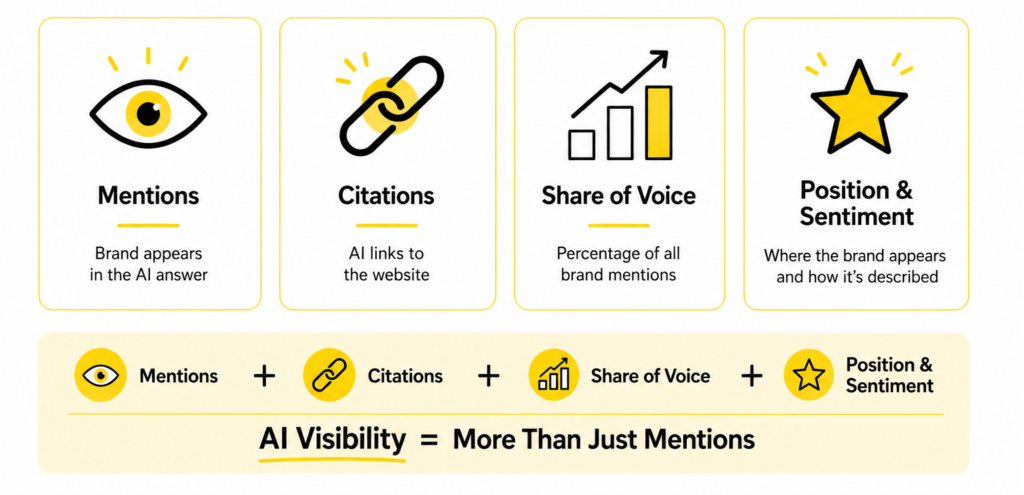
“AI visibility” isn’t a single metric. To get data you can actually use, you need to break it down into four distinct buckets:
- Mentions: Your brand name appears in the text, with or without a link. This is your core visibility metric. It directly drives purchase consideration because the user actively reads your name.
- Citations: The AI links to your website as a source. Think of citations as your referral traffic drivers, whereas mentions are your brand awareness builders.
- Share of Voice (SoV): How often your brand shows up compared to the entire pool of brands the AI surfaces for a relevant prompt. Crucially, the denominator must include every brand the AI names and not just a hand-picked list of your favorite competitors or the number is useless.
- Position and Sentiment: Are you the first recommendation or the fifth? Is the AI framing you as the premium market leader, the budget alternative, or a controversial choice? Large language models tend to anchor on whatever they mention first, making high placement incredibly valuable.
You need to track all four. It’s incredibly common for a brand to have high mentions but zero citations (ChatGPT loves to name-drop without linking), or great citations but terrible share of voice because they always place behind three competitors.
The Five AI Visibility Metrics That Matter
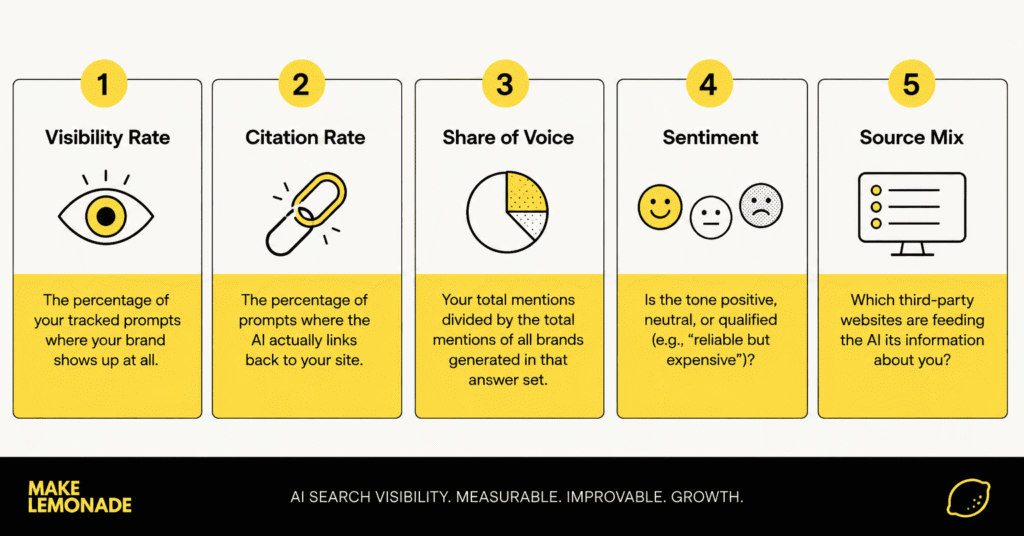
Tracking these metrics helps identify where your brand is visible, where it is being cited, and what areas require improvement.;
- Visibility Rate: The percentage of your tracked prompts where your brand shows up at all.
- Citation Rate: The percentage of prompts where the AI actually links back to your site.
- Share of Voice: Your total mentions divided by the total mentions of all brands generated in that answer set.
- Sentiment: is the tone positive, neutral, or qualified (e.g., “reliable but expensive”)?
- Source Mix: Which third-party websites are feeding the AI its information about you?
You must track these per platform. Visibility rates vary wildly between ChatGPT, Perplexity, Gemini, and Google AI Overviews because their underlying data engines look at different things. Otterly’s 2026 analysis of over a million citations showed that Google AI Overviews have the strongest bias toward established brands. Meanwhile, ChatGPT leans encyclopedic (heavy on Wikipedia and major aggregators), and Perplexity favors community validation (heavy on Reddit and forums).
Three Ways to Track (For Every Budget)
1. Manual Prompt Audits
Best for: Getting started with zero budget.
Build a spreadsheet of 20 to 30 prompts that mirror exactly how your actual customers think. Divide them into three buckets:
- Brand-Direct: “Is [Brand] worth the money?” or “[Brand] vs [Competitor]”
- Category-Level: “Best boutique hotels in Florence” or “Where to stay in Phuket for a honeymoon”
- Scenario-Based: “Luxury hotel in central London with proper afternoon tea” or “Family resort in the Maldives with overwater villas”
Run each prompt three to five times across ChatGPT, Perplexity, Gemini, and Claude using completely fresh, incognito sessions. Log your appearances, position, links, competitors, and the source URLs the AI cites. Running five repetitions across four platforms gives you a baseline of 400 to 600 data points, plenty for a solid quarterly health check.
The downside? Variance. AI answers change from run to run, so small manual samples can sometimes mistake temporary noise for a real trend.
2. Dedicated AI Visibility Tools
Best for: Automated, continuous monitoring at scale.
If you need daily or weekly tracking, you have to automate it. The software market has matured rapidly; legacy SEO tools have launched dedicated modules (Ahrefs Brand Radar, Semrush AI SoV, HubSpot AEO), alongside specialized platforms like Profound, Otterly, Peec AI, Trakkr, and Siftly. Entry-level pricing starts around $99 a month, while enterprise-grade agency tools typically run between $500 and $2,000 a month per client.
Before you buy, ask two critical questions:
- Which models do they actually scrape? Many platforms cover ChatGPT and Perplexity but completely ignore Claude or Grok. For instance, HubSpot’s AEO tool still doesn’t track Claude as of May 2026.
- How do they calculate Share of Voice? If a tool makes you type in your competitors manually upfront, it’s measuring your share of voice within an artificial bubble not the organic pool of brands the AI is naturally recommending.
(Note: This is exactly why we built our own platform, Signal Noir. We query the main models directly and build the competitor set dynamically based on whoever the AI names in real-time.)
3. Downstream Traffic in GA4
Best for: Measuring hard ROI.
On May 13, 2026, Google quietly updated GA4 to include a native “AI Assistant” channel in its Default Channel Group. Traffic coming from recognized AI chatbots now automatically gets tagged with the medium ai-assistant and the campaign (ai-assistant). No custom setup required. You can find this right now under Reports > Acquisition > Traffic Acquisition > Session default channel group.
While it’s useful to finally separate AI traffic from generic referrals and direct visits, keep three caveats in mind for your internal reports:
- The data only exists from May 13, 2026 onward. Drop an annotation in your GA4 property so you don’t misread historical year-over-year comparisons.
- Mobile apps frequently strip out referrer data. If someone clicks a link inside the ChatGPT iOS app, it will likely still land in “Direct.” View your GA4 AI channel as the absolute floor of your traffic, not the ceiling.
- Most AI interactions don’t end in a click. A traveler who reads a glowing review of your property on Perplexity has been heavily influenced, but they may just open a new tab and search your brand name directly. GA4 will never link that back to the AI tool.
The Honest Limits of the Data
Before you present an AI visibility deck to your leadership team, set expectations with three realities:
1. AI responses are non-deterministic. You can run the exact same prompt twice and get different answers. A single bad day isn’t a crisis, and a single good day isn’t a victory. Look for sustained patterns over hundreds of runs.
2. Citations do not equal clicks. As the Pew data proved, click-through rates inside AI engines are incredibly low (around 1%). Track citations for brand authority and search footprint, not as a massive traffic firehose.
3. Unlinked mentions are still wins. If a user asks ChatGPT for advice and reads “The Aman group remains the gold standard for service,” your brand just won a massive psychological victory even if no link was clicked and no analytics pixel fired.
Your Action Plan for This Week
If you are starting from absolute zero, do these five things in this exact order:
- [ ] Step 1: Write down 25 realistic, highly specific customer prompts and save them in a master document.
- [ ] Step 2: Spend an afternoon running them manually across the big four platforms to see exactly how you look to an outsider.
- [ ] Step 3: Calculate your baseline visibility rate and share of voice based on those results.
- [ ] Step 4: Open GA4, add a note on the date you ran the prompt checks, and confirm that traffic from AI tools is being tracked correctly.
- [ ] Step 5: Set a recurring calendar invite to run this exact exercise again in 90 days.
This simple workflow gives you immediate, evidence-based clarity on whether your brand is visible, where you’re winning, and which third-party sites are feeding the algorithms your data. From there, you can make smart decisions about where to spend your budget, whether that’s software monitoring, targeted content updates, or PR campaigns aimed at the media outlets the AI trusts most.
The brands that dominate the AI search era won’t be the ones with the loudest opinions on the technology. They will be the ones who started measuring it first.
Frequently Asked Questions
What is the difference between AEO and GEO?
Answer Engine Optimization (AEO) focuses on optimizing content for conversational chatbots like ChatGPT and Claude to ensure your brand is recommended in direct answers. Generative Engine Optimization (GEO) targets hybrid search engines like Google AI Overviews and Perplexity, optimizing content to fit the specific algorithmic scoring, citation patterns and source selection mechanisms these engines use to construct response layouts.
How often should our brand team audit our AI share of voice?
For most brands, a manual baseline audit should be conducted quarterly. If you are using automated visibility software or operate in a highly dynamic market like luxury travel, a weekly or bi-weekly automated review is recommended to catch shifts caused by algorithm updates or major competitor PR campaigns.
Will traditional SEO strategies help with AI visibility?
Yes, but only to a point. Basic technical health, clear site architecture, and high domain authority still matter because AI engines crawl the web. However, traditional SEO focuses heavily on keyword density and keyword intent matching, whereas AI optimization requires structuring data for authority, securing third-party digital PR citations, and building explicit brand associations across trusted platforms like Wikipedia, Reddit, and industry-specific trade publications.
Make Lemonade is a boutique consultancy specializing in AI search optimization for luxury hospitality and travel brands. If you’d like to understand how your brand appears across ChatGPT, Gemini, Perplexity and Claude, request an AI Visibility Audit