

Luxury travel is built on reputation. Guests do not book a hotel, villa, resort, retreat, or yacht experience because they saw it once. They book when the brand feels trusted, relevant, and aligned with the trip they want.
Digital PR helps create that trust online.
It places your brand in the right publications, earns mentions from credible sources, builds backlinks, supports SEO, and helps AI search tools understand what your brand should be known for.
For luxury travel and hospitality brands, digital PR is no longer just about press coverage. It is about visibility across search engines, AI tools, travel publications, review platforms, and the digital sources guests use before they enquire or book.
What Is Digital PR?
Digital PR is the process of earning online visibility through editorial coverage, backlinks, brand mentions, expert commentary, awards, partnerships, and reputation-building campaigns.
For luxury travel and hospitality brands, this can include:
- Features in luxury travel publications
- Hotel, resort, or villa reviews
- Destination guide mentions
- Founder, GM, chef, spa director, or designer interviews
- Awards and rankings
- Journalist outreach
- Press trip coverage
- Influencer and creator partnerships
- Travel advisor visibility
- Brand mentions in trusted online sources
- AI search visibility support
The goal is not just to get coverage. The goal is to build a stronger digital footprint so guests, journalists, advisors, search engines, and AI systems understand why your brand matters.
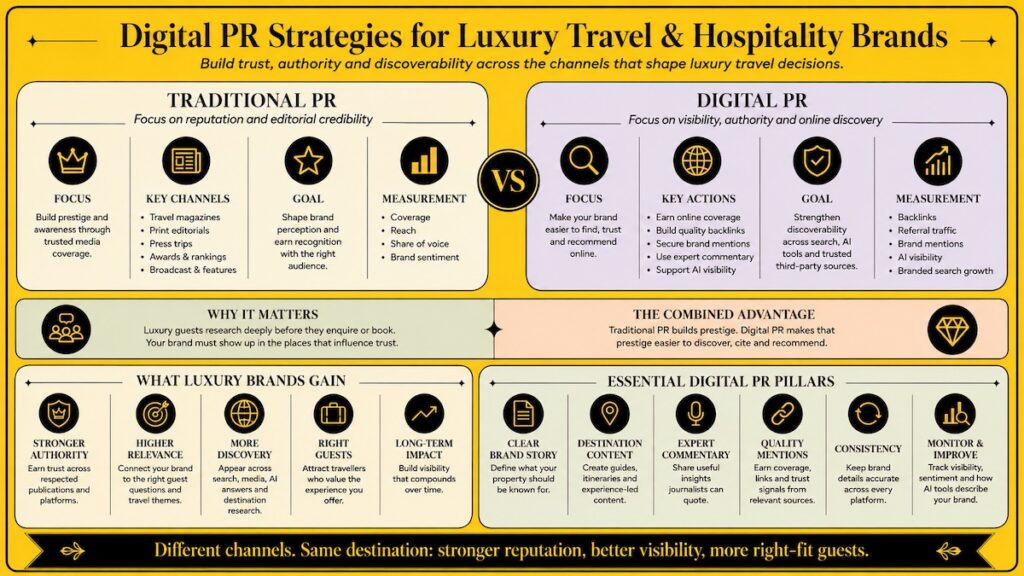
Digital PR vs Traditional PR
Traditional PR focuses on reputation, media relationships, press trips, print features, broadcast coverage, and public perception.
Digital PR adds search and discoverability.
It focuses on:
- Online editorial coverage
- Backlinks
- Referral traffic
- Brand mentions
- Search visibility
- AI visibility
- Third-party authority
- Measurable digital impact
Traditional PR builds credibility.
Digital PR makes that credibility easier to find.
For luxury travel brands, the strongest approach combines both. A print feature can build prestige. An online feature with a backlink, clear brand mention, and strong positioning can keep supporting visibility long after publication.
Why Digital PR Matters for Luxury Travel and Hospitality
Luxury guests research deeply before making a decision.
Before booking, they may check:
- Google results
- AI-generated recommendations
- Editorial reviews
- TikTok or YouTube
- Travel advisor suggestions
- Tripadvisor
- Booking platforms
- Awards
- Destination guides
- Brand websites
- Press features
- Guest reviews
Digital PR helps your brand appear across these touchpoints.
It supports three important goals:
- Visibility: helping the right audience discover your brand
- Credibility: showing that trusted sources recognise your brand
- Authority: helping search engines and AI tools understand your relevance
This matters because AI tools now influence travel discovery. A guest may ask ChatGPT, Perplexity, Gemini, or Google AI search tools to compare hotels, shortlist destinations, or suggest the best resort for a honeymoon, wellness trip, or family escape.
If your brand is not clearly represented online, AI may miss you, describe you poorly, or recommend a competitor.
Start With a Clear Brand Story
Digital PR works best when the brand story is clear.
Many luxury hospitality brands use phrases like:
- World-class service
- Unforgettable escape
- Hidden gem
- Bespoke experience
- Authentic journey
- Luxury redefined
- Sanctuary of calm
These phrases are not enough on their own. They need proof.
Before pitching journalists or building campaigns, define what your brand should be known for.
Ask:
- What makes the property or experience different?
- Who is the ideal guest?
- What travel occasion do you serve best?
- What destination story do you belong to?
- What experiences are genuinely distinctive?
- What proof supports your positioning?
- What should journalists, guests, and AI systems associate with your brand?
Your answer may be:
- Quiet luxury
- Private island escape
- Family-friendly luxury
- Design-led boutique hospitality
- Conservation-led safari
- Culinary travel
- Sleep and wellness retreat
- Romantic honeymoon setting
- Multigenerational travel
- Ultra-private villa collection
- Slow travel
- Cultural immersion
A clear story makes your PR sharper. Instead of pitching a generic “luxury hotel,” you build authority around a specific travel need, destination, or experience.
Build Digital PR Around Guest Intent
Digital PR should support what your ideal guests are already searching for.
Luxury travellers may ask:
- Where should I stay for a honeymoon?
- Which resort is best for privacy?
- Which hotel has the best spa?
- Which property is best for families?
- Which destination feels less crowded?
- Which villa is best for a milestone celebration?
- Which safari lodge offers the best guiding?
- Which retreat is best for recovery and wellness?
Use these questions to shape campaigns.
For example:
- A wellness resort can focus on sleep tourism, longevity, recovery, spa rituals, and digital detox.
- A boutique hotel can focus on design, neighbourhood culture, slow travel, and food-led discovery.
- A safari lodge can focus on conservation, expert guiding, family safaris, and private wilderness.
- A villa brand can focus on privacy, multigenerational travel, celebration stays, and discreet service.
- A culinary hotel can focus on destination dining, chef-led experiences, and local producers.
This makes coverage more relevant to guests, journalists, search engines, and AI systems.
Create Press-Worthy Content Assets
Journalists need useful stories. Guests need reassurance. Search engines and AI tools need clear information.
Strong content assets can support all three.
Destination Guides
Destination guides help connect your brand to the wider travel experience.
Useful ideas include:
- Best time to visit the destination
- Where to stay for a luxury weekend
- How to spend three days in the destination
- Food and wine guide
- Wellness guide
- Family travel guide
- Honeymoon itinerary
- Design lover’s guide
- Cultural guide
- Hidden experiences guide
- Seasonal travel guide
These guides can support SEO, PR outreach, and AI visibility.
Original Travel Insights
Original insights make your pitches stronger.
Luxury travel brands can build stories from:
- Booking trends
- Guest preferences
- Seasonal demand
- Honeymoon enquiries
- Wellness programme interest
- Dining preferences
- Family travel patterns
- Concierge requests
- Sustainability questions
- Private transfer requests
Example:
If a villa brand sees more enquiries for three-generation family trips, that can support a campaign around multigenerational luxury travel.
If a resort sees more demand for sleep-focused stays, that can support a wellness travel story.
Visual Assets
Luxury travel is visual. Good visuals make coverage easier to secure.
Prepare:
- High-resolution property photography
- Room, suite, villa, and residence images
- Restaurant and bar imagery
- Spa and wellness visuals
- Destination photography
- Drone footage
- Short-form video clips
- Portraits of chefs, guides, designers, or spa experts
- Press-ready brand decks
- Experience one-pagers
Make it easy for journalists to tell the story well.
Earn Coverage in the Right Publications
Luxury brands do not need to appear everywhere. They need to appear in the right places.
Relevant publications may include:
- Luxury travel magazines
- Destination publications
- Lifestyle media
- Design and architecture publications
- Food and drink media
- Wellness publications
- Wedding and honeymoon platforms
- Family travel publications
- Sustainability and responsible travel media
- Travel advisor platforms
- High-net-worth audience publications
The key question is:
Does this publication influence the audience, search environment, or AI ecosystem that matters to us?
Some coverage builds prestige. Some coverage drives referral traffic. Some coverage earns backlinks. Some coverage helps AI tools understand your brand.
The best digital PR strategy considers all of these outcomes.
Pitch Strong Angles, Not Generic Announcements
Journalists do not need another pitch about a beautiful hotel with unforgettable experiences.
They need a clear story.
Better angles include:
- Why travellers are choosing quieter luxury destinations
- How sleep tourism is changing wellness travel
- The rise of multigenerational luxury travel
- Why privacy is becoming a core luxury expectation
- How design-led hotels are shaping destination identity
- How culinary travel is influencing hotel choice
- Why slow travel is changing luxury itineraries
- How conservation-led travel is influencing safari bookings
- Why off-season travel appeals to affluent guests
- How luxury hospitality is responding to longer stays
A strong pitch should include:
- A clear subject line
- A short story angle
- Why it matters now
- Brand relevance
- Expert quote
- Useful data or insight
- Strong visuals
- Contact details
- Link to press assets
Keep it short and specific.
Use Expert Commentary to Build Authority
Luxury travel brands often have strong expertise in the business.
Useful expert voices include:
- Founders
- General managers
- Hotel owners
- Chefs
- Spa directors
- Wellness practitioners
- Interior designers
- Architects
- Concierges
- Safari guides
- Destination specialists
- Sustainability leads
They can comment on:
- Travel trends
- Guest expectations
- Destination demand
- Wellness and longevity
- Luxury service
- Sustainable travel
- Food and wine tourism
- Design and architecture
- Private travel
- Family travel
- Celebration travel
Expert commentary should be useful, not promotional.
Example:
“Luxury travellers are not only asking for better rooms or more amenities. They are looking for privacy, ease, and a stay that feels quietly thought through.”
This kind of comment gives journalists a useful angle while strengthening brand authority.
Build Authority With High-Quality Backlinks
Backlinks still matter for SEO and digital authority.
For luxury travel brands, strong backlinks may come from:
- Editorial features
- Destination guides
- Awards pages
- Travel advisor networks
- Tourism boards
- Hotel associations
- Partner pages
- Event listings
- Restaurant and spa features
- Sustainability certifications
- Design publications
- Local cultural institutions
The best links are contextual.
Examples:
- A wellness resort linked to a sleep tourism article
- A safari lodge linked from a conservation travel guide
- A boutique hotel linked to a design-led city guide
- A villa brand linked from a multigenerational travel feature
- A restaurant hotel linked to a culinary destination guide
These links help connect your brand with the topics and experiences you want to own.
Make Awards and Rankings Work Harder
Awards can build trust, but they should not sit only in a press release.
Relevant awards may include:
- Luxury hotel awards
- Spa and wellness awards
- Design awards
- Sustainability awards
- Restaurant awards
- Destination awards
- Boutique hotel rankings
- Family travel awards
- Honeymoon travel awards
- Travel advisor awards
Once earned, use awards across:
- Website copy
- Press page
- About page
- Room or experience pages
- Google Business Profile
- Social media
- Email campaigns
- Sales decks
- Travel advisor materials
- Digital PR pitches
If an award supports your positioning, make it visible where guests and search systems can find it.
Strengthen Third-Party Brand Signals
Your website is only one part of your digital footprint.
Luxury guests, search engines, and AI systems also rely on third-party sources, including:
- Google Business Profile
- Bing Places
- Tripadvisor
- Booking platforms
- Luxury travel directories
- Tourism board listings
- Travel advisor platforms
- Restaurant and spa directories
- Social profiles
- Partner websites
- Media coverage
Keep these profiles accurate.
Check:
- Brand name
- Location
- Property type
- Description
- Amenities
- Room categories
- Restaurants and bars
- Spa and wellness facilities
- Experiences
- Awards
- Images
- Contact details
- Website link
Inconsistent information weakens trust. It can also make it harder for AI systems to recommend your brand accurately.
Use Reviews as a PR Asset
Reviews show what guests actually value.
Look for repeated mentions of:
- Privacy
- Service
- Food
- Design
- Views
- Wellness
- Beach access
- Family-friendliness
- Romance
- Concierge support
- Cultural experiences
- Staff warmth
- Room comfort
- Sense of place
Use these patterns to sharpen your messaging.
For example:
- If guests praise the peaceful atmosphere, build PR around quiet luxury and restorative travel.
- If families mention thoughtful service, strengthen your family-friendly luxury positioning.
- If guests praise the food, build stronger culinary travel stories.
- If couples describe the property as private and romantic, improve honeymoon messaging.
- If reviews mention local experiences, connect the brand more clearly to the destination.
Do not copy reviews unnaturally. Use them to understand what your brand is already known for.
Create Campaigns Around Relevant Travel Trends
Trend-led campaigns work when the trend genuinely fits the brand.
Potential themes include:
- Quiet luxury travel
- Sleep tourism
- Longevity retreats
- Private island escapes
- Multigenerational travel
- Slow travel
- Culinary tourism
- Destination dining
- Conscious luxury
- Design-led hotels
- Off-season travel
- Luxury rail journeys
- Remote work retreats
- Private group travel
- Celebration travel
- Women-led travel experiences
- Conservation-led travel
- Digital detox retreats
Choose themes your brand can credibly own.
A wellness resort should focus on wellness, recovery, sleep, longevity, and digital detox.
A private villa brand should focus on privacy, group travel, family gatherings, and milestone celebrations.
A boutique hotel should focus on design, neighbourhood culture, food, and local immersion.
A safari lodge should focus on wildlife, conservation, expert guiding, and once-in-a-lifetime travel.
Combine Digital PR With AI Visibility
AI search has changed what digital PR can do.
PR coverage no longer influences only people. It can also influence the systems people use to make decisions.
AI tools summarise information from trusted online sources. That means digital PR can shape how AI systems understand and describe your brand.
Strong digital PR can help your brand become associated with:
- A destination
- A travel style
- A guest type
- A hospitality category
- A specific experience
- A luxury trend
- A trust signal
- A comparison set
For example:
If your property is consistently mentioned in trusted sources around “quiet luxury in the Cotswolds,” AI is more likely to understand that association.
If your villa brand is repeatedly mentioned around “multigenerational luxury travel in Greece,” that connection becomes stronger.
This is why PR, SEO, content, and AI visibility should work together.
Optimise PR for AI Discoverability
Digital PR campaigns should ask two questions:
Will this coverage influence the right people?
Will this coverage help search engines and AI systems understand the brand better?
To support AI discoverability, aim to:
- Earn clear brand mentions
- Secure contextual backlinks
- Use consistent brand descriptions
- Build authority around specific themes
- Create crawlable online coverage
- Update brand profiles and listings
- Publish expert commentary
- Connect PR stories to relevant website content
- Strengthen third-party trust signals
- Track how AI tools describe the brand
This is where Make Lemonade’s AI Visibility Snapshot can help brands understand how AI currently sees them, where they are being missed, and what needs to change.
You can also use an AI Visibility Roadmap to turn those findings into a clear action plan, or an AI Visibility Programme for ongoing implementation and monitoring.
Internal Linking Opportunities for Make Lemonade
Use these internal links naturally within the article:
AI Visibility Snapshot
Best placement: Optimise PR for AI Discoverability
Suggested anchor text:
- AI Visibility Snapshot
- Find out how AI currently sees your brand
- understand where your property stands in AI search
AI Visibility Roadmap
Best placement: Combine Digital PR with AI Visibility
Suggested anchor text:
- AI Visibility Roadmap
- turn AI visibility findings into a clear plan
- build a prioritised AI visibility strategy
AI Visibility Programme
Best placement: How Long Does Digital PR Take to Show Results? or conclusion
Suggested anchor text:
- AI Visibility Programme
- build long-term AI visibility resilience
- ongoing AI visibility support
AI Search Optimisation Checklist
Best placement: Digital PR Checklist for Luxury Travel and Hospitality Brands
Suggested anchor text:
- AI Search Optimisation Checklist
- review your current AI visibility foundations
- check whether your brand is ready for AI-led discovery
AI Visibility Audit Tool
Best placement: Measure Digital PR Performance
Suggested anchor text:
- AI Visibility Audit Tool
- audit your AI visibility
- check your visibility across AI search platforms
Research Page
Best placement: Why Digital PR Matters for Luxury Travel and Hospitality
Suggested anchor text:
- Make Lemonade’s AI visibility research
- research into AI search and luxury travel discovery
- Invisible or Influential?
Measure Digital PR Performance
Do not measure digital PR only by coverage volume.
Track:
- Quality of publications
- Relevance of coverage
- Backlinks earned
- Referral traffic
- Brand mentions
- Branded search growth
- Organic visibility growth
- AI search mentions
- Share of voice
- Sentiment
- Travel advisor interest
- Enquiries or bookings influenced
- Accuracy of third-party listings
- Competitor visibility in AI answers
Ask:
- Did the coverage reach the right audience?
- Did it support our positioning?
- Did it earn a useful backlink?
- Did it improve visibility for a key destination, theme, or experience?
- Did it create long-term search value?
- Did it help AI tools understand the brand?
- Did it generate qualified interest?
For AI-specific measurement, test real prompts across platforms.
Examples:
- Best luxury hotels in [destination]
- Best wellness retreats in [region]
- Best honeymoon resorts in [destination]
- Best family-friendly luxury resorts in [destination]
- Best private villas for multigenerational travel
- Compare [brand name] with [competitor]
Track whether your brand appears, how it is described, and which sources AI tools use.
Common Digital PR Mistakes Luxury Brands Should Avoid
Chasing Coverage Without Strategy
Coverage is only useful if it supports a clear goal.
Before pitching, ask:
- What do we want to be known for?
- Who needs to see this?
- What source would make this more credible?
- What page should this coverage support?
- What guest question does this help answer?
Using Generic Pitches
Avoid pitches built only around:
- Beautiful rooms
- Great service
- Luxury experiences
- Stunning location
- New package
- Seasonal offer
Instead, give journalists a timely and specific story.
Ignoring SEO Value
A feature can be beautiful and still miss search value.
Where appropriate, coverage should include:
- Accurate brand name
- Correct website link
- Relevant destination context
- Clear description
- Key experience or positioning
- Useful imagery
- Up-to-date details
Treating PR and SEO as Separate Teams
Digital PR works best when PR, SEO, content, and brand teams share the same strategy.
PR understands the story. SEO understands demand. Content supports the journey. AI visibility shows how the wider web interprets the brand.
Not Repurposing Coverage
A strong feature should keep working after publication.
Reuse quality coverage across:
- Website press pages
- Social media
- Email newsletters
- Travel advisor decks
- Sales materials
- Award submissions
- Partnership decks
- Future pitches
Digital PR Checklist for Luxury Travel and Hospitality Brands
Use this checklist to review your strategy:
- Define your brand story clearly.
- Identify the guest segments you want to reach.
- Build story angles around real travel trends.
- Create destination and experience-led content.
- Prepare high-quality press assets.
- Pitch relevant publications, not just high-volume outlets.
- Use expert commentary to build authority.
- Earn contextual backlinks where possible.
- Keep third-party listings accurate.
- Align brand descriptions across platforms.
- Use guest reviews to refine messaging.
- Turn awards and rankings into lasting visibility.
- Monitor branded search and referral traffic.
- Track AI search mentions and recommendations.
- Connect PR campaigns with SEO and content strategy.
- Review how AI tools describe your brand regularly.
This is a natural place to link to Make Lemonade’s AI Search Optimisation Checklist.
How Long Does Digital PR Take to Show Results?
Digital PR is not instant.
Some results can appear quickly, especially when a strong story lands in a relevant publication. The deeper value builds over time through repeated authority signals.
First Month
Focus on foundations:
- Review your brand story.
- Audit current coverage.
- Check third-party listings.
- Identify priority publications.
- Review how AI tools describe your brand.
- Build a list of target guest questions.
- Prepare press assets.
Next Three Months
Build momentum:
- Pitch relevant stories.
- Publish destination or experience-led content.
- Secure expert commentary opportunities.
- Improve internal links between PR, content, and service pages.
- Update third-party profiles.
- Track backlinks and brand mentions.
- Monitor early AI visibility changes.
Six to Twelve Months
Build authority:
- Develop deeper content clusters.
- Earn stronger editorial mentions.
- Build authority around key themes.
- Track competitor visibility.
- Refresh campaigns based on trends.
- Use PR insights to improve website messaging.
- Continue monitoring AI search results.
Digital PR works best as a long-term system, not a one-off campaign.
Conclusion
Digital PR helps luxury travel and hospitality brands build visibility, authority, and trust in the places that influence booking decisions.
It supports more than media coverage. It helps your brand appear in trusted publications, earn useful backlinks, strengthen search visibility, improve third-party signals, and become easier for AI tools to understand and recommend.
At Make Lemonade, we help luxury hospitality and travel brands understand how they appear across search, AI systems, and digital media. Our work combines brand strategy, digital intelligence, AI visibility research, citation analysis, and practical implementation.
We can help you see how AI currently understands your brand through an AI Visibility Snapshot, turn those findings into a clear AI Visibility Roadmap, and support long-term visibility with an AI Visibility Programme.
We also create practical tools and resources, including an AI Visibility Audit Tool and an AI Search Optimisation Checklist, to help brands understand where they stand before deciding what to do next.
Your brand may already have the reputation, product, and story.
Our role is to make sure that reputation travels further across search, AI systems, third-party sources, and the digital spaces where luxury discovery now happens.
At Make Lemonade, we do not just optimise for search.
We optimise for significance.
FAQs
What is digital PR in luxury travel?
Digital PR in luxury travel is the process of earning online coverage, backlinks, brand mentions, and trusted visibility for hotels, resorts, villas, destinations, and travel brands.
Why is digital PR important for hospitality brands?
Digital PR helps hospitality brands build trust, earn third-party validation, improve search visibility, attract the right guests, and strengthen their reputation across online discovery platforms.
What are the best digital PR strategies for hotels?
The best strategies include editorial outreach, destination content, expert commentary, awards, review-led storytelling, high-quality backlinks, trend-led campaigns, third-party listing accuracy, and AI visibility monitoring.
How does digital PR help SEO?
Digital PR helps SEO by earning backlinks, brand mentions, referral traffic, and authority signals from trusted websites. It also connects your brand to relevant destinations, guest needs, and travel themes.
Can digital PR help luxury brands appear in AI search results?
Yes. Digital PR can help AI tools understand and recommend a brand by creating strong third-party signals, contextual mentions, authoritative coverage, and consistent brand information across the web.
What makes a good digital PR campaign for a luxury hotel?
A good campaign has a clear story angle, strong visuals, relevance to the right audience, a timely hook, credible proof, and a connection to the hotel’s positioning.
How should luxury brands measure digital PR?
Luxury brands should measure publication quality, relevance, backlinks, referral traffic, branded search growth, AI mentions, sentiment, qualified enquiries, and long-term authority growth.
Written by
Sara Lemos
Co-founder of Make Lemonade. Sara leads AI visibility strategy and digital intelligence, helping luxury hospitality and travel brands appear in AI-generated recommendations.
View full profileMake Lemonade
Find out how your brand currently performs in AI-generated recommendations.
The AI Visibility Snapshot gives you a clear picture of how AI systems currently see, describe, and recommend your brand, and where the gaps are. No jargon. No obligation to go further.