


Luxury travel has always been shaped by reputation.
The right editorial feature, the right travel advisor relationship, the right guest recommendation, and the right brand story can place a hotel, resort, villa, yacht, or destination in front of the right audience.
That still matters.
But discovery has changed.
Affluent travellers are no longer relying only on Google searches, travel magazines, concierge recommendations, or Instagram inspiration. Many are now asking AI tools to help them plan honeymoons, family escapes, private island stays, wellness retreats, safari itineraries, yacht charters, and once-in-a-lifetime holidays.
They are not just searching for broad terms like “luxury hotel in the Maldives.”
They are asking detailed questions such as:
- What is the best barefoot luxury resort in the Maldives for a couple that wants privacy, diving, and excellent food?
- Which boutique hotels in Tuscany feel romantic but not too formal?
- What are the best luxury family resorts in Europe with kids’ clubs, good restaurants, and easy airport access?
- Plan a five-night luxury itinerary in Marrakech with a calm hotel, spa, design-led interiors, and authentic local experiences.
In these moments, AI tools do more than provide information. They shape consideration. They suggest names. They summarise reputations. They decide which brands are visible and which brands are left out.
For luxury hospitality and travel brands, the question is no longer only:
Do we rank on Google?
The sharper question is:
When our ideal guest asks AI for a recommendation, does our brand appear?
What AI Search Visibility Means
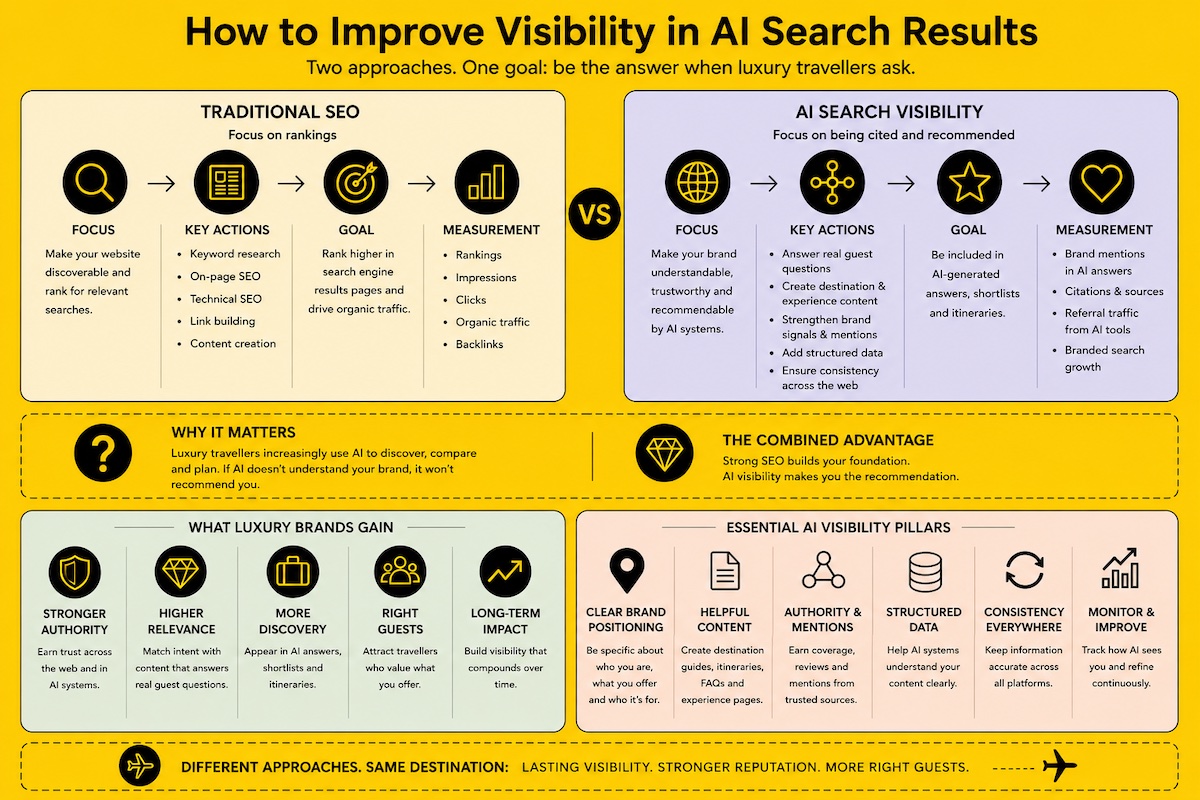
AI search visibility is the ability of your brand to be found, understood, cited, and recommended by AI-powered search tools.
These tools include:
- Google AI Overviews
- Google AI Mode
- ChatGPT Search
- Bing Copilot
- Perplexity
- Gemini
- Claude
- Other AI-led discovery platforms
In traditional search, the goal was often to appear high on a search results page.
In AI search, the goal is different.
Your brand needs to become part of the answer.
That may mean:
- Your hotel is named in a shortlist.
- Your destination guide is cited as a source.
- Your villa collection is mentioned in a recommendation.
- Your restaurant, spa, or experience is included in an AI-generated itinerary.
- Your brand is surfaced when travellers ask for the “best” option for a specific occasion.
For luxury brands, this matters because high-value guests often make decisions through layered discovery.
They may see you in editorial, hear about you from an advisor, visit your Instagram, read reviews, and then ask AI to compare or validate their choices.
If AI does not understand your brand clearly, it may fail to recommend you, even if your reputation is strong elsewhere.
Why AI Search Matters for Luxury Travel and Hospitality
Luxury travel decisions are emotional, personal, and trust-led.
Guests are not simply looking for a bed. They are looking for taste, privacy, atmosphere, service, memory, and reassurance.
AI search is now becoming part of that decision-making journey.
A potential guest may use AI to:
- Compare resorts before speaking to a travel advisor
- Shortlist private villas for a family office
- Plan a honeymoon itinerary before visiting booking sites
- Research emerging destinations
- Compare wellness retreats, safari lodges, yachts, or boutique hotels
- Validate whether a property matches their taste and expectations
This creates a quiet risk for luxury brands.
You may have a beautiful website, strong press coverage, loyal guests, and an excellent product, but still be poorly represented in AI-generated answers.
The problem is not always invisibility.
Sometimes, the problem is inaccurate visibility.
AI may:
- Describe your brand too generically
- Miss your strongest differentiators
- Associate you with the wrong audience
- Recommend a competitor because their content is clearer
- Use outdated or incomplete information about your property
- Fail to connect your brand with your strongest travel themes
For luxury travel and hospitality, AI visibility is about protecting and extending reputation in a discovery environment.
AI Search Is Not a Replacement for SEO
AI search optimization does not replace SEO. It builds on it.
Your website still needs to be crawlable. Your content still needs to answer real questions. Your brand still needs authority. Your technical setup still matters. Your digital PR, reviews, partnerships, and editorial mentions still influence how your brand is understood online.
The difference is that AI search rewards clarity in a new way.
It needs to understand:
- Who you are
- What type of guests do you serve
- Where are you located
- What makes your experience distinct
- What you are known for
- Which publications, partners, or guests validate your reputation
- How does your offering compare to others
- What kind of travel moments are you best suited for
A luxury resort that describes itself only as “an unforgettable escape” gives AI very little to work with.
A luxury resort that clearly explains its location, design philosophy, room types, culinary programme, wellness offer, guest profile, nearby experiences, sustainability credentials, awards, reviews, and ideal occasions becomes much easier to understand and recommend.
Start With a Clear Brand Position
Before you optimize for AI search, your brand needs to be clear.
Luxury hospitality websites often sound beautiful but vague. The language may be elegant, but it does not always help search engines or AI systems understand the brand.
Phrases like these may sound refined, but they are not enough on their own:
- Timeless elegance
- Unforgettable experiences
- A sanctuary of calm
- Where luxury meets authenticity
- A hidden gem
- A bespoke escape
Your website should clearly answer:
- What kind of property or travel brand are you?
- Where are you located?
- Who is your ideal guest?
- What occasions are you best suited for?
- What makes the experience distinctive?
- What level of service do you provide?
- What facilities, experiences, and amenities do you offer?
- What nearby destinations or attractions matter?
- What awards, press mentions, or guest reviews support your reputation?
Example
Instead of saying:
“An intimate retreat where luxury meets nature.”
Say:
“An adults-only boutique resort in the Seychelles designed for couples seeking privacy, ocean-view villas, slow dining, guided snorkelling, and wellness-led stays.”
The second version still feels premium, but it gives AI systems much more context.
Make Your Website Easy for AI to Understand
Luxury websites are often visually beautiful, but sometimes difficult for search systems to read.
Important information may be hidden inside:
- Image-heavy layouts
- PDFs
- Interactive modules
- Video
- Minimal brand copy
- Design-led pages with very little text
For AI visibility, beauty and clarity need to work together.
Your website should include clear, crawlable information about:
- Rooms, suites, villas, or residences
- Restaurants and bars
- Spa and wellness facilities
- Experiences and excursions
- Weddings, honeymoons, or private events
- Family travel facilities
- Accessibility details
- Sustainability practices
- Location and transfer details
- Seasonality and the best time to visit
- Awards and press mentions
- Guest reviews and testimonials
- FAQs
Do not assume AI will understand your brand from imagery alone.
If something matters to a guest, it should also exist as clear written content on the page.
Build Content Around Real Guest Questions
AI search is conversational.
People ask detailed questions, not just short keywords.
Luxury travel brands should create content that answers the questions guests, advisors, journalists, and planners actually ask.
These may include:
- Best time to visit your destination
- How many nights to stay
- What to pack
- How to choose between room categories
- What makes your location different from nearby destinations
- Best experiences for couples
- Best experiences for families
- How to plan a honeymoon itinerary
- How to plan a wellness retreat
- What to do during the rainy season
- How to combine your property with other destinations
- What makes your culinary programme special
- How airport transfers work
- What guests should know before arrival
This content does not need to feel cheap, generic, or keyword-stuffed.
It can still feel editorial, refined, and brand-led.
Example Content Ideas for a Luxury Hotel in Florence
A luxury hotel in Florence could publish:
- How to Spend Three Slow Days in Florence
- Where to Stay in Florence for Art, Food, and Quiet Luxury
- A Design Lover’s Guide to Florence
- Florence for Couples: A Romantic Long Weekend Itinerary
- Best Time to Visit Florence for Fewer Crowds and Better Dining
This kind of content helps AI understand the property’s relationship with the destination, guest intent, and travel style.
Create Destination and Experience Guides
Luxury travel decisions are rarely made around a room alone.
Guests choose the wider experience.
That is why destination content matters.
A resort, hotel, villa, yacht charter company, or travel brand should not only describe its product. It should help shape the trip.
Useful content formats include:
- Destination guides
- Seasonal travel guides
- Neighbourhood guides
- Itinerary suggestions
- Wellness retreat guides
- Family travel guides
- Honeymoon guides
- Food and culture guides
- Private experience guides
- Event and celebration planning guides
Example Content Ideas for a Luxury Safari Lodge
A luxury safari lodge could create content around:
- What to Expect on Your First Luxury Safari
- Best Time to Visit Botswana for Wildlife Viewing
- How to Plan a Safari and Beach Honeymoon
- Private Safari vs Group Safari: Which Is Right for You?
- What Makes a Conservation-Led Safari Different?
These pages help AI associate the brand with specific experiences, locations, and guest needs.
Use Specific Language, Not Generic Luxury Claims
AI search needs specificity.
So do discerning guests.
Luxury brands should avoid relying only on broad claims such as:
- World-class service
- Unforgettable experience
- Hidden gem
- Luxury escape
- Bespoke journey
- Authentic experience
- Award-winning hospitality
These phrases can be useful when supported, but weak when used alone.
Instead, add proof and detail.
Stronger Examples
- Private butler service for each villa
- Two-Michelin-starred culinary direction
- Thirty-minute private boat transfer from Malé
- Family villas with separate children’s sleeping areas
- Adults-only wellness retreat with daily guided breathwork
- Restored 18th-century palazzo within walking distance of the Duomo
- Private yacht charters across the Cyclades with chef-led dining
Specificity helps AI understand what makes your brand relevant for different queries.
It also helps guests feel more confident.
Strengthen Your Brand Entity
AI systems need to understand your brand as a clear entity.
That means your brand information should be consistent across your website, Google Business Profile, Bing Places, social channels, travel directories, review platforms, media coverage, partner websites, and booking platforms.
Check whether your brand is consistently described across:
- Your website
- Google Business Profile
- Bing Places
- Tripadvisor
- Condé Nast Traveller mentions
- Travel + Leisure mentions
- Forbes Travel Guide
- Michelin Guide, where relevant
- Virtuoso, Serandipians, Traveller Made, or other advisor networks
- Booking platforms
- PR agency pages
- Tourism board listings
- Local destination websites
Your name, location, category, description, images, amenities, and service details should be accurate and aligned.
If your website positions you as a design-led boutique hotel, but third-party listings describe you only as a generic hotel, AI may not fully understand your positioning.
Earn the Right Third-Party Mentions
Luxury discovery has always depended on reputation outside your own channels.
That remains true in AI search.
AI systems often look for patterns of trust across the wider web. Your own website matters, but third-party mentions help validate your brand.
Valuable sources may include:
- Luxury travel publications
- Hotel awards
- Travel advisor networks
- Tourism boards
- High-quality directories
- Partner websites
- Review platforms
- Editorial features
- Interviews
- Podcasts
- Destination guides
- Restaurant and spa listings
- Sustainability certifications
- Architecture and design publications
The quality of the mention matters more than the quantity.
A thoughtful feature in a respected travel publication is more valuable than dozens of low-quality directory listings.
Your PR, SEO, and content strategy should work together. Press coverage should not disappear after publication. It should support your wider digital authority.
Make Editorial Coverage Work Harder
Luxury brands invest heavily in PR, but AI search changes what happens after a feature goes live.
A beautiful editorial placement may influence readers, but it can also influence AI systems if the coverage is crawlable, specific, and connected to your brand’s core themes.
For example, if your resort is known for wellness, your digital footprint should make that clear across your website, press, reviews, interviews, and partner mentions.
That means building consistent signals around themes such as:
- Sleep retreats
- Longevity
- Spa rituals
- Mindful travel
- Thermal bathing
- Nutrition
- Yoga
- Nature immersion
- Medical wellness
- Digital detox
If those ideas appear only in one brochure or one campaign, they may not be strong enough.
If they appear across your website, PR coverage, expert commentary, reviews, and destination content, AI has a clearer pattern to understand.
Use Structured Data
Structured data, also known as schema markup, helps search engines understand what a page is about.
For luxury travel and hospitality brands, useful schema types may include:
- Organization schema
- Hotel schema
- LocalBusiness schema
- Restaurant schema
- Article schema
- FAQPage schema
- BreadcrumbList schema
- Review schema
- Product or Offer schema, where appropriate
- Event schema for weddings, retreats, or seasonal events
Schema does not guarantee AI visibility. But it helps create a cleaner technical layer around your content.
Make sure the schema matches the visible content on the page.
Do not mark up reviews, prices, amenities, or services that are not actually shown to users.
Improve Your About Page
Your About page is more important than many brands realise.
For AI search, it helps define who you are.
For luxury guests, it helps create trust.
A strong About page should include:
- Your brand story
- Your location
- Your ownership or leadership, where appropriate
- Your design philosophy
- Your hospitality philosophy
- Your audience
- Your key experiences
- Your awards and recognition
- Your sustainability commitments
- Your press mentions
- Your connection to the destination
Avoid making it purely poetic.
It should be beautiful, but also clear.
If your hotel is family-owned, restored from a historic building, led by a known designer, or deeply connected to local culture, say so clearly.
These details help AI and guests understand why your brand deserves attention.
Add Clear FAQs to Important Pages
FAQs are useful because they match how people ask AI tools questions.
For luxury travel and hospitality websites, useful FAQs may include:
- How do guests reach the property?
- Is the resort suitable for families?
- Is the hotel adults-only?
- What is the best time of year to visit?
- Are private transfers available?
- Does the property offer honeymoon packages?
- Are dietary requirements accommodated?
- Is the spa open to non-residents?
- Can the property host private events or weddings?
- What experiences can be arranged through the concierge?
FAQs should be specific and genuinely helpful.
Avoid adding vague questions just to fill space.
Keep Content Fresh
Luxury travel changes constantly.
New restaurants open. Flight routes shift. Seasonal experiences change. Awards are announced. Renovations happen. Menus change. Wellness programmes evolve.
AI systems and guests both benefit from updated information.
Review important pages regularly, especially:
- Destination guides
- Experience pages
- Restaurant pages
- Spa and wellness pages
- Wedding and event pages
- Seasonal offer pages
- Press and awards pages
- FAQs
- Room and villa descriptions
If a page talks about “new for 2024” and it is still live in 2026, it weakens trust.
Make Reviews and Guest Sentiment Part of the Strategy
Reviews are not just conversion tools.
They also help shape how your brand is understood.
Look for repeated phrases in guest reviews. These often reveal what people truly value.
Guests may repeatedly mention:
- Discreet service
- Exceptional food
- Privacy
- Design
- Views
- Family-friendliness
- Romantic atmosphere
- Staff warmth
- Wellness facilities
- Location
- Concierge support
- Beach quality
- Cultural access
Use these insights in your content.
For example:
- If guests consistently praise your quiet atmosphere, your brand should own that positioning more clearly.
- If guests repeatedly mention the concierge, your content should explain how the concierge experience works.
- If families praise your staff and room layouts, your family travel content should reflect that.
- If couples describe the property as private and romantic, your honeymoon and anniversary pages should make that clear.
Do not copy reviews unnaturally into your content.
Instead, use guest sentiment to refine your messaging.
Create Content for Travel Advisors and Partners
AI search is not only used by guests.
Travel advisors, PR teams, journalists, wedding planners, and corporate retreat planners may also use AI tools during research.
Create content that helps these audiences understand your brand quickly.
This may include:
- Advisor-friendly fact sheets
- Media pages
- Press rooms
- Downloadable brand assets
- Clear room category guides
- Experience summaries
- Sample itineraries
- Event capacity information
- Sustainability credentials
- High-resolution image galleries
- Contact details for trade and press
The easier your brand is to understand and verify, the stronger your visibility becomes across both human and AI-led research.
Monitor How AI Describes Your Brand
You cannot improve what you do not monitor.
Luxury brands should regularly test how AI platforms describe them.
Ask questions such as:
- What is [brand name] known for?
- Is [brand name] a luxury hotel?
- Who is [brand name] best suited for?
- What are the best luxury hotels in [destination]?
- What are the best boutique hotels in [destination]?
- What are the best wellness resorts in [region]?
- What are the best hotels for honeymooners in [destination]?
- Compare [brand name] with [competitor name].
Track whether the answers are:
- Accurate
- Flattering
- Incomplete
- Outdated
- Too generic
- Wrong
- Missing your strongest differentiators
If AI is missing key details, that usually means your digital signals are not strong or clear enough.
Common Mistakes Luxury Brands Make With AI Search
Relying Too Much on Beautiful but Vague Copy
Luxury copy should create emotion, but it also needs to communicate clearly.
If your website is too abstract, AI may struggle to understand what you actually offer.
Treating AI Visibility as a Technical Add-On
AI visibility is not just a plugin, schema fix, or one-time SEO task.
It touches:
- Brand strategy
- Content
- PR
- Technical SEO
- Digital reputation
- Guest reviews
- Third-party mentions
- Website messaging
Ignoring Third-Party Signals
Your own website is only part of the picture.
AI systems also look at how the wider web describes and validates your brand.
Forgetting the Destination
Guests do not choose a hotel in isolation.
They choose:
- A place
- A mood
- A season
- A reason to travel
- A level of service
- A style of experience
Your content should connect your brand to that wider journey.
Not Checking AI Results Regularly
AI search results change.
Your competitors may appear for queries where you should be visible. Regular monitoring helps you spot gaps before they become commercial problems.
Practical AI Visibility Checklist for Luxury Travel Brands
Use this checklist to review your current visibility:
- Make your brand positioning clear on key pages.
- Rewrite vague luxury claims with specific details.
- Ensure your website is crawlable and technically healthy.
- Create destination and experience-led content.
- Add useful FAQs to service, room, destination, and experience pages.
- Keep your Google Business Profile and third-party listings accurate.
- Strengthen your About page with real brand details.
- Add relevant schema markup.
- Update old content regularly.
- Earn high-quality editorial and industry mentions.
- Make PR, SEO, and content teams work from the same messaging.
- Monitor how AI tools describe and recommend your brand.
- Track competitor visibility in AI-generated answers.
- Use guest reviews to understand what your brand is truly known for.
How Long Does AI Visibility Take?
AI visibility is not instant.
It depends on your current website, brand authority, content depth, PR footprint, and competitive landscape.
Some improvements can happen quickly. Clearer website copy, stronger FAQs, better schema, and updated listings can improve how your brand is understood.
Other improvements take longer. Building authority, earning high-quality mentions, creating content clusters, and shifting how AI systems associate your brand with certain travel themes may take several months.
First Month
Focus on the foundations:
- Audit how AI currently sees your brand.
- Fix obvious technical issues.
- Improve core messaging.
- Review your most important pages.
- Check your third-party listings for accuracy.
- Identify where AI is misrepresenting or missing your brand.
Next Three Months
Build stronger signals:
- Strengthen priority pages.
- Build destination content.
- Add FAQs.
- Improve entity signals.
- Align third-party listings.
- Create content around high-value guest questions.
- Add schema where relevant.
- Review guest sentiment and update messaging.
Six to Twelve Months
Build authority and consistency:
- Invest in stronger editorial mentions.
- Build deeper content clusters.
- Improve authority around key travel themes.
- Monitor AI search visibility regularly.
- Update content based on what AI tools are missing.
- Align PR, SEO, and brand messaging more closely.
- Track competitor visibility across AI search tools.
AI visibility is not something you do once.
It is something you maintain.
Conclusion
Luxury travel and hospitality brands have always cared deeply about how they are seen.
The difference now is that visibility is no longer shaped only by editors, advisors, guests, search engines, and social platforms.
AI also shapes it.
When a high-value traveller asks for the best resort, hotel, villa, retreat, yacht, or itinerary, AI may influence which names enter the conversation.
That makes AI visibility a reputation issue, not just a marketing issue.
At Make Lemonade, we help luxury hospitality and travel brands understand:
- How AI currently sees them
- Where they are being missed
- Where they are being misrepresented
- Which content gaps are weakening visibility
- Which third-party signals need to be strengthened
- How their brand can become clearer across AI-led discovery platforms
We do not replace your PR team, creative agency, or existing marketing partners.
We make their work go further by helping your brand become clearer, more discoverable, and more resilient across the AI-led systems now shaping travel discovery.
Your brand may already be beautiful, respected, and loved by guests.
Our role is to make sure AI can find it, understand it, and surface it when it matters.
At Make Lemonade, we believe your reputation is your greatest asset.
Let’s make sure AI knows it.

Written by
Sara Lemos
Co-founder of Make Lemonade. Sara leads AI visibility strategy and digital intelligence, helping luxury hospitality and travel brands appear in AI-generated recommendations.
View full profileMake Lemonade
Find out how your brand currently performs in AI-generated recommendations.
The AI Visibility Snapshot gives you a clear picture of how AI systems currently see, describe, and recommend your brand, and where the gaps are. No jargon. No obligation to go further.