


Key takeaways
- Running ChatGPT Ads won’t make ChatGPT more likely to mention, cite or recommend your brand. OpenAI says ads don’t influence its answers.
- Ads appear below ChatGPT’s response, are labelled as sponsored and are matched to the context of the conversation rather than to exact keywords.
- People on Plus, Pro, Business, Enterprise and Edu plans won’t see ads at all, so the answer is the only way to reach them inside ChatGPT.
- Getting into the answer depends on the wider information about your brand, and credible third-party coverage carries a lot of weight.
- Paid and organic AI visibility do different jobs and should be reported separately. Most brands will need both.
OpenAI started testing ads in ChatGPT in February 2026, initially with logged-in adult users on the Free and Go plans in the US. It has moved quickly since. In August 2026 OpenAI announced it had reached a $1 billion annualised revenue run rate roughly 200 days after launch. In October it expanded to 26 more countries, taking ChatGPT Ads to 89, and said more than 100,000 advertisers had used the platform.
Related reading: AI Mentions vs Citations: What’s the Difference? and Google Has Started Booking Hotels Through AI
What ChatGPT Ads actually are
The ads sit below ChatGPT’s response, are labelled as sponsored and are visually separate from the answer.
Advertisers can pick one of three objectives:
- Views (charged at cost per thousand impressions)
- Clicks (charged at cost per click)
- Conversions (optimises towards an action on your site, and is charged by clicks or impressions rather than per conversion)
Ad performance tracking runs through OpenAI’s Pixel, its Conversions API or third-party measurement partners, and Ads Manager reports the numbers you’d expect: impressions, clicks, spend, CTR, average CPC, average CPM and conversions.
OpenAI is still adding to the format. In late October it began rolling out a wider standard ad card on desktop and opened multi-image ads to all advertisers in beta.
The biggest new format is Sponsored Agents, which OpenAI started testing in September.
After seeing an ad, a user can open a separate, labelled conversation with an agent sponsored by the business, ask it questions and click through to the website when they’re ready. So far OpenAI has described it as a test with selected US advertisers.
Do ads change what ChatGPT says?
No. OpenAI calls this “answer independence”, and it’s one of the five principles it has set out for advertising. Its Help Center is fairly matter of fact about it: ads run on separate systems from the chat model, and advertisers have no way to shape, rank or alter responses. Sponsored Agent conversations are kept apart from ChatGPT’s own answers too.
That’s OpenAI’s own account, and there’s no public controlled test of it yet. The early data does show little overlap between ads and answers, though. SE Ranking’s study of more than 50,000 commercial prompts found the advertiser was also cited in the answer in 3.63% of ad placements, and LLM Pulse found that 2.8% of ads matched a source cited in the same answer. Both are observational, so they can’t prove cause, but they’re a useful sense check.
And this is how that plays out.
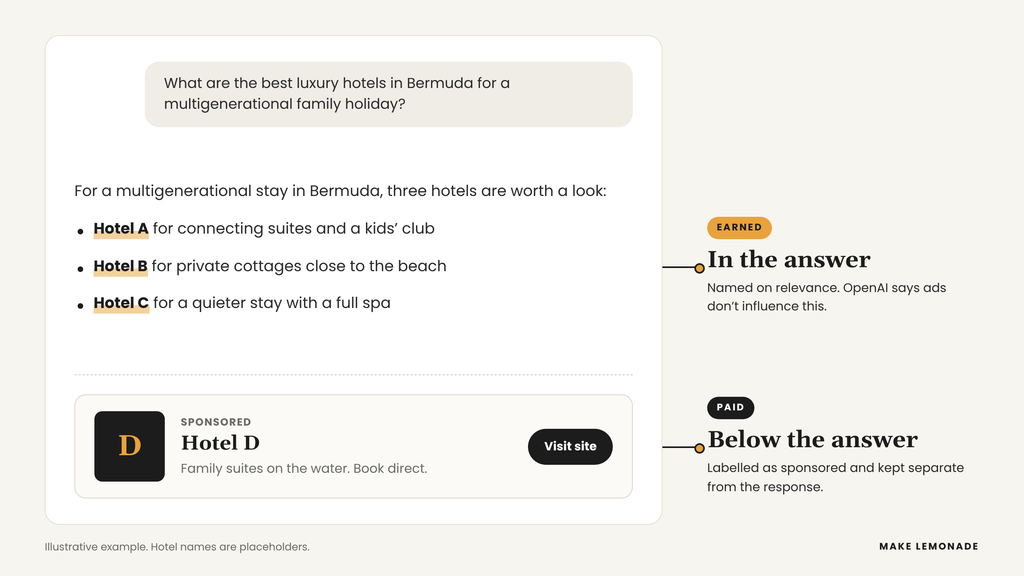
Say a traveller asks ChatGPT for the best luxury hotels in Bermuda for a multigenerational family holiday. A hotel could turn up in two places.
It might be named in the answer itself, which is earned visibility.
Or it might appear in the sponsored slot underneath, which is paid for.
You can have both. Paying for the ad just won’t get you the first one.
If you’ve ever run Google Ads alongside SEO, this will feel familiar. PPC can buy you the top of the page, but it has never bought anyone an organic ranking. ChatGPT now has the same split. The mechanics differ because people are having a conversation rather than typing in a keyword, but the principle is the same.
How ads get matched to conversations
There’s no keyword list in the traditional sense. According to OpenAI, the system looks at the context and intent of the conversation, plus the ad’s landing page, headline and copy. If a user has ad personalisation switched on, some signals from their wider ChatGPT use come into it as well. Advertisers can add what OpenAI calls context hints to describe the kinds of conversations where their offer fits, but these aren’t exact-match keywords and placement isn’t guaranteed.
For travel brands, that opens up conversations like where to stay for a long weekend in Bermuda, which Caribbean hotels suit families, which wellness retreats near London are worth the money, or where to take the team for an incentive trip. A hotel could reach someone asking those questions without that person ever having searched for its name. These are people who are exploring, comparing and deciding, and for hospitality brands that’s a stage of the journey worth being present in.
One catch. OpenAI doesn’t show ads to anyone on Plus, Pro, Business, Enterprise or Edu plans, or to accounts it identifies as belonging to under-18s. The only way to reach those users inside ChatGPT is through the answer.
What your ad budget won’t buy
Paying for ChatGPT Ads won’t get you mentioned or recommended in the answer. It won’t get you cited, and it won’t tell ChatGPT your brand is more authoritative than a competitor’s.
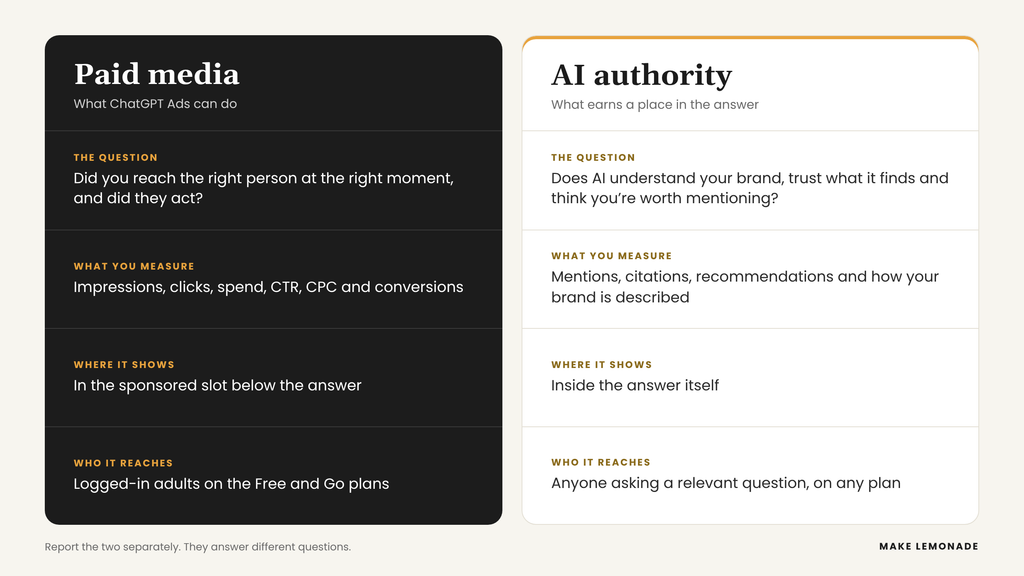
That has a practical consequence for reporting. Paid exposure in ChatGPT isn’t organic AI visibility and shouldn’t be reported as if it were, because the two answer different questions. Paid media is about whether you reached the right person at the right moment and whether they did something. AI authority is about whether, when someone asks a relevant question, the AI understands your brand, trusts what it finds about you and thinks you’re worth mentioning.
So how do you get into the answer?
There isn’t a switch for it. In Make Lemonade’s experience, it comes down to the whole information environment around a brand: how clearly your own site explains what you offer, whether that information is technically accessible, how consistently you’re described across the web, and what credible third parties say about you.
That last part carries a lot of weight. A University of Toronto study from September 2025 found that AI search engines lean heavily towards earned, third-party sources over brand-owned content. Muck Rack’s October 2026 report, covering ChatGPT, Claude, Gemini and Perplexity, found that more than 84% of AI citations still come from earned and third-party sources. Journalism’s share fell from 27% in May to 22% in September, and paid or advertorial content made up just 0.3% of September citations.
For luxury travel, that puts editorial coverage, respected travel titles, reviews and destination sites right at the centre. Schema and well-structured content on your own site still help. They’re just not enough on their own. What matters is whether you’ve built enough credibility, in a form machines can read, across the sources AI platforms actually draw on.
Paid and organic work better together
None of this is an argument against ChatGPT Ads. Paid campaigns give you reach around high-value conversations straight away, while organic work builds the authority that earns you a place in the answer. One rents attention. The other earns inclusion.
What’s different from the paid search and SEO balance most marketers know is what you’re competing for. It’s less about a ranking position and more about whether you’re in the answer at all.
Is it worth testing ChatGPT Ads now?
Yes, as long as expectations are realistic. Ads Manager is still in beta and there isn’t much reliable benchmark data yet. OpenAI suggests starting CPC bids at $3 to $5. In one early third-party test, SE Ranking saw a click-through rate of around 1.3% from more than 97,000 impressions, but very few sign-ups afterwards. Early figures like these are best treated as a rough guide rather than a benchmark.
Just test it for the right reason. Advertising can buy you visibility around an AI conversation, but it can’t buy you AI authority. If you want ChatGPT, Gemini, Perplexity and the rest to recognise and recommend you on their own, that’s a separate job, and most brands are going to need both.
Want to know how AI currently sees your brand? Start with an AI Visibility Snapshot.
FAQs about ChatGPT Ads and AI visibility
Can you pay to be recommended by ChatGPT?
No. OpenAI says ads don’t influence ChatGPT’s answers, and advertisers can’t shape, rank or alter its responses.
Where do ChatGPT Ads appear?
Below ChatGPT’s response, labelled as sponsored and kept visually separate from the answer.
Who sees ChatGPT Ads?
Logged-in adults on the Free and Go plans. People on Plus, Pro, Business, Enterprise and Edu plans don’t see ads, and neither do accounts identified as belonging to under-18s.
What is answer independence?
It’s one of OpenAI’s five advertising principles, and it commits that ads don’t influence the answers ChatGPT gives.
Does advertising in ChatGPT improve AI visibility?
It gives you paid visibility around conversations, but it doesn’t improve organic mentions, citations or recommendations. Those depend on your website, how accessible your information is and what credible third-party sources say about your brand.
Sources
- OpenAI Help Center: Ads in ChatGPT
- OpenAI Help Center: Ads in ChatGPT, The Basics
- OpenAI Help Center: Create Campaigns for ChatGPT Ads
- OpenAI: Testing ads in ChatGPT
- OpenAI: A milestone in expanding access to AI
- Muck Rack: What is AI Reading? (October 2026)
Previous article
AI Search Is Turning Reputation Into a Search Signal